



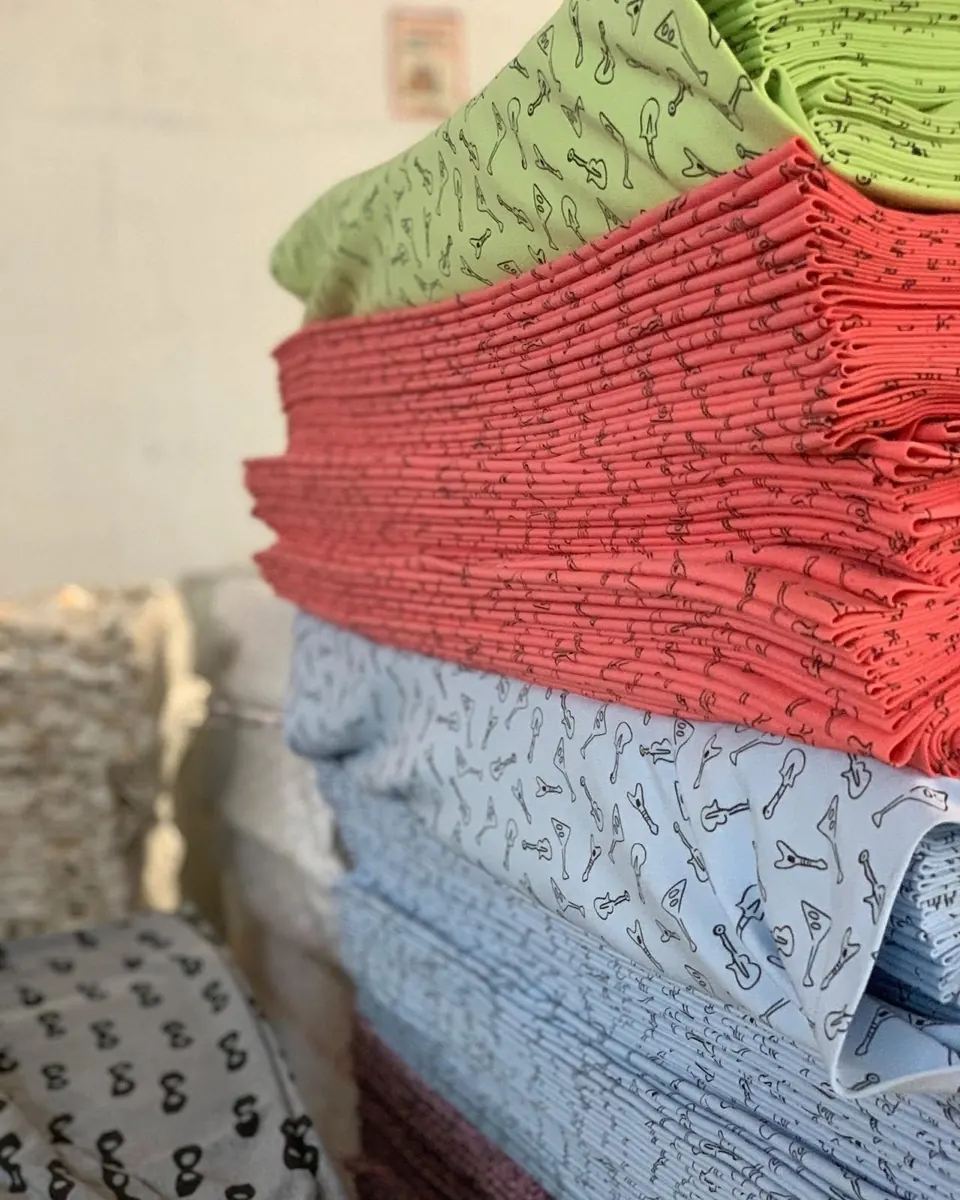
Open a print-to-pattern release case
Send the relevant parties one identified dress pattern and a named print reference, not a request to reproduce whatever appears in a thumbnail. The case should state whether the buyer wants an existing printed material or a new artwork proposal requiring confirmation. Archive references such as ALT-PR-1007 identify a design discussion, while PR-111 and PR-112 identify different substrate records; they must occupy separate fields. Ask the supplier which actual fabric-design-colourway pairing it can offer and what physical reference represents it. No new printing service or permitted artwork use should be assumed from catalogue inclusion.
Request the physical facts needed to position the pattern
Have the offered reference identify motif scale, repeat dimensions, direction and usable printed width in a way the cutter can verify. Attach the current front, back and other actual component outlines with neckline, seam and hem boundaries visible. The first useful output is a scaled layout showing how those outlines relate to the real print. Mark any unresolved dimension explicitly rather than letting the cutter measure a browser screenshot. If the supplier offers another substrate or repeat version, return it as a distinct proposal instead of quietly updating the original reference.
Catalogue starting points
The material record for PR-111 is printed single jersey, 100% combed cotton, 140, 150, 160, 170, 180 g/m² with Reactive print finishing. PR-112 is printed interlock, 100% combed cotton, 190, 205, 220, 235, 250 g/m² with Pigment print finishing. These records do not establish a selected artwork's current availability, licence, repeat dimensions or performance. Identify the actually offered weight and finish in the release case. Keep the two routes separate because a print-to-pattern decision on one construction does not qualify the other or every image in the archive.
Have the designer decide the exceptions before cutting
Return the scaled layout with concrete visual questions: may a dominant motif cross the neckline, must a side seam match, and what interruption is acceptable at the hem or a specified opening? Have the design owner annotate those exact areas as accepted, revised or unresolved. This produces instructions the cutter can execute rather than a general demand for good placement. If artwork permission or ownership is unclear, resolve that separately before commissioning development. An attractive layout does not establish legal permission, and permission alone does not approve the garment composition.
Return the layout consequence to the commercial decision
Ask the cutter to identify the marker and additional material implied by the selected placement restrictions, distinguishing those design choices from any agreed inspection rejection. Request the work and cost needed for the proposed sample, including controlled cutting or a sewn matching junction where relevant. If the supplier or garment maker cannot confirm a required arrangement, show that exception to the design owner instead of inventing a production promise. The decision may be to relax a matching rule, change the motif or evaluate another offer; each should carry its own revised layout and cost evidence.
Use a sewn junction to close the disputed placement
Where the layout leaves a critical uncertainty, ask the sample maker to assemble that exact panel relationship with the intended seam and finishing allowance. Retain both the pre-sewing placement view and the finished junction, then have the authorised reviewer decide whether the stated visual requirement is met. CottonWorks describes assembly through actual seams and components; a paper alignment cannot replace the relevant sewn evidence. If a care assessment is needed for the printed material, assign it to the quality specialist with the offered supply identified rather than treating this visual trial as a fastness test.
CottonWorks: Garment Construction — seams and components — Actual seam and component construction matters in assembly. The print-to-pattern exception case and sewn-junction release are original editorial handoff recommendations, not confirmation that custom placement or manufacturing services are offered.
Issue one controlled instruction or return an unresolved case
The release output should identify the physical print reference, substrate and colourway, pattern revision, permitted panel directions, critical placement annotations, agreed variation and the evidence that closed each exception. Record who approved that actual instruction and which questions remain open. A later motif resize or material substitution should reopen the affected case rather than inherit approval by design name. Keep commercial confirmation of the offered supply and artwork-use permission attached but distinct. This hands production an executable printed-dress instruction without turning an archive image, successful sample or process label into a universal manufacturing commitment.
Technical background and scope
This is a structured editorial draft. Garment-specific development advice is paired with existing catalogue records; compatibility must be established by sampling. AL KUMAŞ supplies fabric. Cutting, sewing and finished-garment production are separate unless explicitly agreed.