



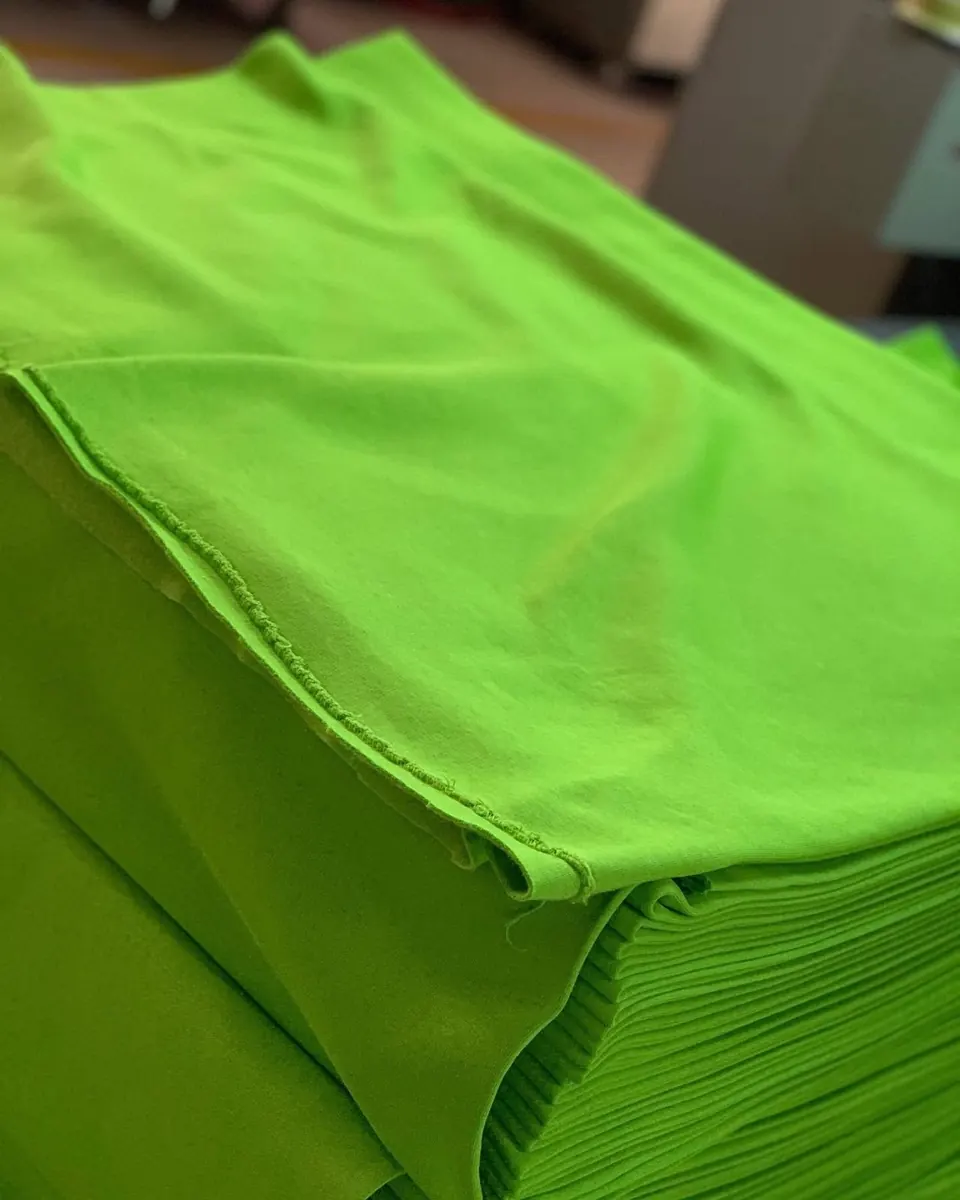
Cost a waist-supported straight skirt with its actual lower opening
Use the accepted skirt panels, waistband components, hem and any specified walking opening as the basis for material planning. A generic close-fit dress estimate does not include the same waist system or component arrangement. Send the real midi length, size ratio and direction requirements to the cutter. If two lower-outline proposals remain under review, identify them separately instead of blending their consumption into one unexplained allowance. A material quotation should represent the skirt the buyer can approve, not an attractive rib price whose pattern and waist components are still assumed.
Use the listed weights without rounding them into equivalence
RB-302 lists 220, 240, 260, 280 and 300 g/m², while FR-401 lists 230, 250, 270, 290 and 310 g/m². Their numerical ranges overlap, but those recorded options share no exact weight. Ask which finished target each supplier offer represents and cost the accepted sample at that version. Equal cotton-elastane percentages do not isolate construction or finish differences. GSM states mass per area, not waistband performance or the way a long rib panel hangs, so do not use the nearest number as evidence of an equivalent complete garment.
Expose waistband material as a separate quantity
For an invented component calculation, suppose a cut rectangle for a proposed waistband is nine by ninety centimetres. Its area is 810 square centimetres, or 0.081 square metres. At a hypothetical 240 g/m², that represents 19.44 grams before marker losses or other components. These dimensions are not a developed waist size, finished band depth or AL KUMAŞ offer. Any elastic, facing or support has its own requirement. The example shows why a waistband cannot be treated as weightless trim or bought twice when the body estimate already includes its actual pattern pieces.
Keep approved rib direction and measurement state in the marker brief
Ask the maker and supplier how usable width is stated for the actual offered material, and send the developed panel direction to the cutter. Do not rotate a piece merely to improve a diagram if that changes the assessed visual or fit relationship. Request the marker using the real size mix and identify which waist pieces are included. A change of width or length may alter placement, so preserve the version represented by each estimate. The buyer needs an actual cutting calculation rather than a claim that every rib supplied at a nominal width yields the same straight skirt.
Price a walking-opening revision as a defined change
If the designer adds or changes an opening, ask which panel allowances, edge components and operations are affected. Simply leaving a seam unjoined does not establish the complete finished construction or a material saving. American & Efird describes assembly communication through seam drawings and stitch details, supporting a concrete scope for the maker's quotation. It does not provide a universal skirt-operation charge. A revised hem or waist proposal likewise needs its affected cost references updated before the buyer compares it with an earlier closed-side or differently supported version.
American & Efird: Stitches and Seams — Assembly can be communicated through seam drawings and stitch details. The waistband rectangle and mass calculation are original hypothetical arithmetic, not a developed waist size, marker yield or source-derived operation price.
Catalogue starting points
The RB-302 material description is 95% cotton 5% elastane, 2×2 rib, 220, 240, 260, 280, 300 g/m² and Enzyme + compacted. FR-401 is 95% cotton 5% elastane, fine rib, 230, 250, 270, 290, 310 g/m² and Silicone + compacted. Neither record gives usable width, waistband consumption or a skirt marker. Confirm the offered finished versions and what components each would supply. The shared blend cannot establish equal directional behaviour, support requirements or complete material cost per accepted midi skirt.
Attach the actual waist and hem proposition to the price
Show material identities, panel direction, waist system, midi length, opening, marker and assembly references together. Identify separate support or closure materials and any agreed allowances without inventing standard losses or minimums. Ask for actual commercial terms against the stated quantity. If fitting changes waist position or the lower outline, reconcile the consumption before proceeding. The economic decision can then explain whether a difference comes from body mass, pattern layout or developed components, rather than presenting the cheapest rib kilogram as a qualified straight-skirt offer.
Technical background and scope
This is a structured editorial draft. Garment-specific development advice is paired with existing catalogue records; compatibility must be established by sampling. AL KUMAŞ supplies fabric. Cutting, sewing and finished-garment production are separate unless explicitly agreed.