



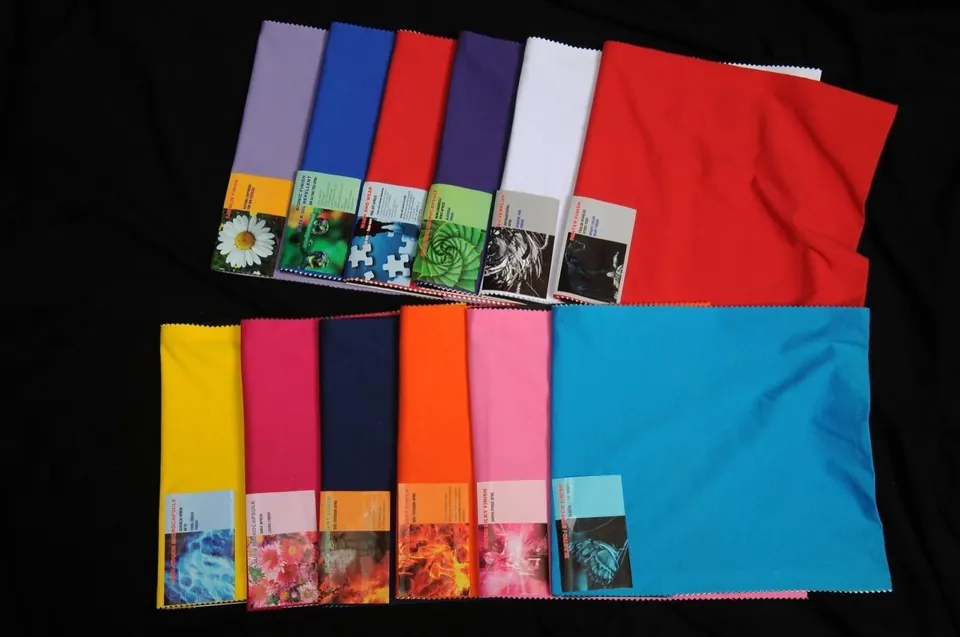
Assess colour on a garment that is actually extended
A leggings colour can look convincing on a relaxed swatch and still need further development when used in a close-fitting pattern. Begin with the intended colourway, pattern and coverage requirement. Ask the colour team to distinguish the shade approval from the appearance of the stretched garment. For this product, the seat, knee and waistband are useful places to observe the selected material under representative movement. Record the sample and lighting conditions rather than treating a phone photograph as a repeatable colour decision.
Keep the two substrate routes separate
PF-121 is listed as 92% recycled polyester and 8% elastane at 130, 142, 154, 166 and 178 g/m². IN-202 is 92% cotton and 8% elastane interlock at 220, 235, 250, 265 and 280 g/m². Do not transfer a colour or print approval between these articles merely because both contain elastane. Ask the processor to confirm which decoration routes it can evaluate on the exact proposed substrate and finish. This catalogue does not establish printing availability, colourfastness results or a guaranteed appearance for either route.
Approve the base shade before judging contrast panels
Define the governing reference for the body colour, then identify whether the waistband, mesh insert, pocket bag or stitching is intended to match or contrast. A deliberate contrast needs its own approved relationship, not an accidental near-match. Review the components together in their intended positions. If the garment includes a light panel next to a dark one, ask the technical team what colour-transfer evidence is appropriate for the combination. Record component codes and reference versions so a subsequent trim substitution does not quietly change the approved colour story.
Draw the print across the seam plan
For a directional motif or an engineered graphic, send the decorator the actual panel shapes and state where the design must appear when worn. Decide whether matching at the outside leg seam is essential, optional or deliberately avoided. Include the graded sizes: a placement that fits the sample size may sit differently on another panel. Approve the artwork layout separately from the decorated cutting. CottonWorks treats visual design and construction as connected development decisions; here, the garment maker must determine the specific implications for placement and cutting yield.
CottonWorks: Designing Knit Textiles — construction and visual design — Construction and visual-design development are connected. Leggings panel placement and grading suggestions are garment-development applications, not documented AL KUMAŞ capabilities.
Inspect decoration during movement without inventing limits
Request a sewn trial using the intended application, not only an unstretched print sample. Observe whether the graphic opens, distorts or changes its apparent contrast during the planned movements. For a small logo, examine its location against a seam, pocket or fold as well as its flat appearance. Agree how the team will judge any observed change before making an approval decision. A visual development trial is not a certification or a substitute for a defined durability assessment where a measurable requirement applies.
Separate shade approval from fastness evidence
AATCC lists distinct methods addressing rubbing, perspiration and laundering colourfastness. Those categories help frame questions for the testing provider; they do not prove that the proposed leggings have passed any test. Ask the laboratory to select the appropriate current methods and agree the requirements for the intended end use. Keep the report tied to the tested article, colour and decoration. A dark colour that looks attractive during a fitting should not acquire unsupported claims about resistance to sweat, washing or transfer to other clothing.
AATCC: Standard Test Methods and Procedures — Public index lists separate colourfastness methods for crocking/rubbing (TM8), perspiration (TM15), and laundering (TM61). No procedures, pass thresholds or results are reproduced or inferred.
Release a complete colourway record
The approval package should contain the body article and finish, governing reference, component colours, artwork version, placement drawing and comments on the worn trial. State what remains conditional, such as final decorated-material evidence or a revised seam placement. If only the solid base shade is accepted, say that explicitly rather than marking the entire leggings programme approved. Give production and purchasing the same dated record. A later request for a new colour needs its own evaluation; it is not automatically covered by the appearance of the first sample.
Technical background and scope
This is a structured editorial draft. Garment-specific development advice is paired with existing catalogue records; compatibility must be established by sampling. AL KUMAŞ supplies fabric. Cutting, sewing and finished-garment production are separate unless explicitly agreed.