



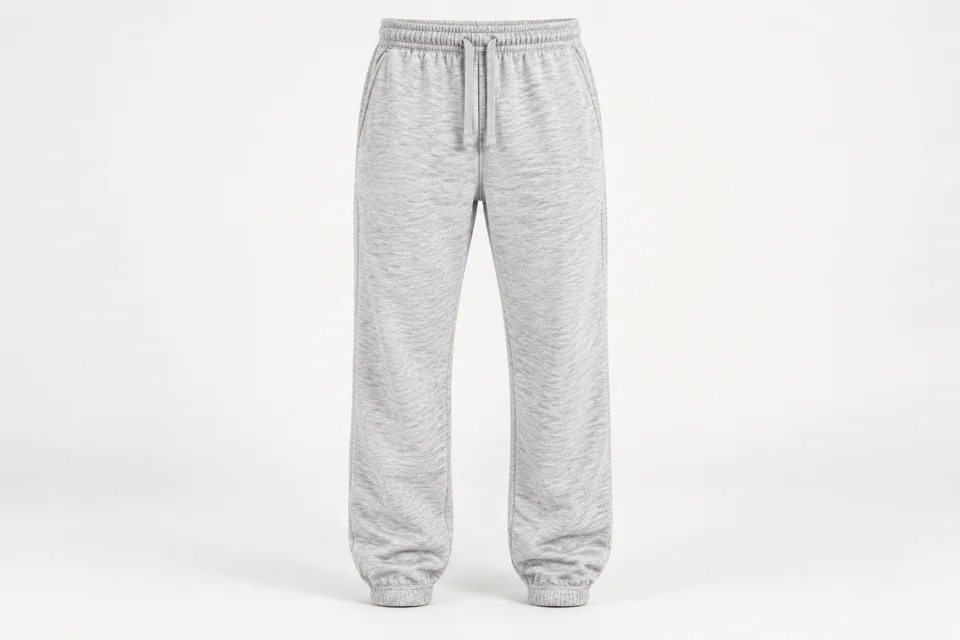


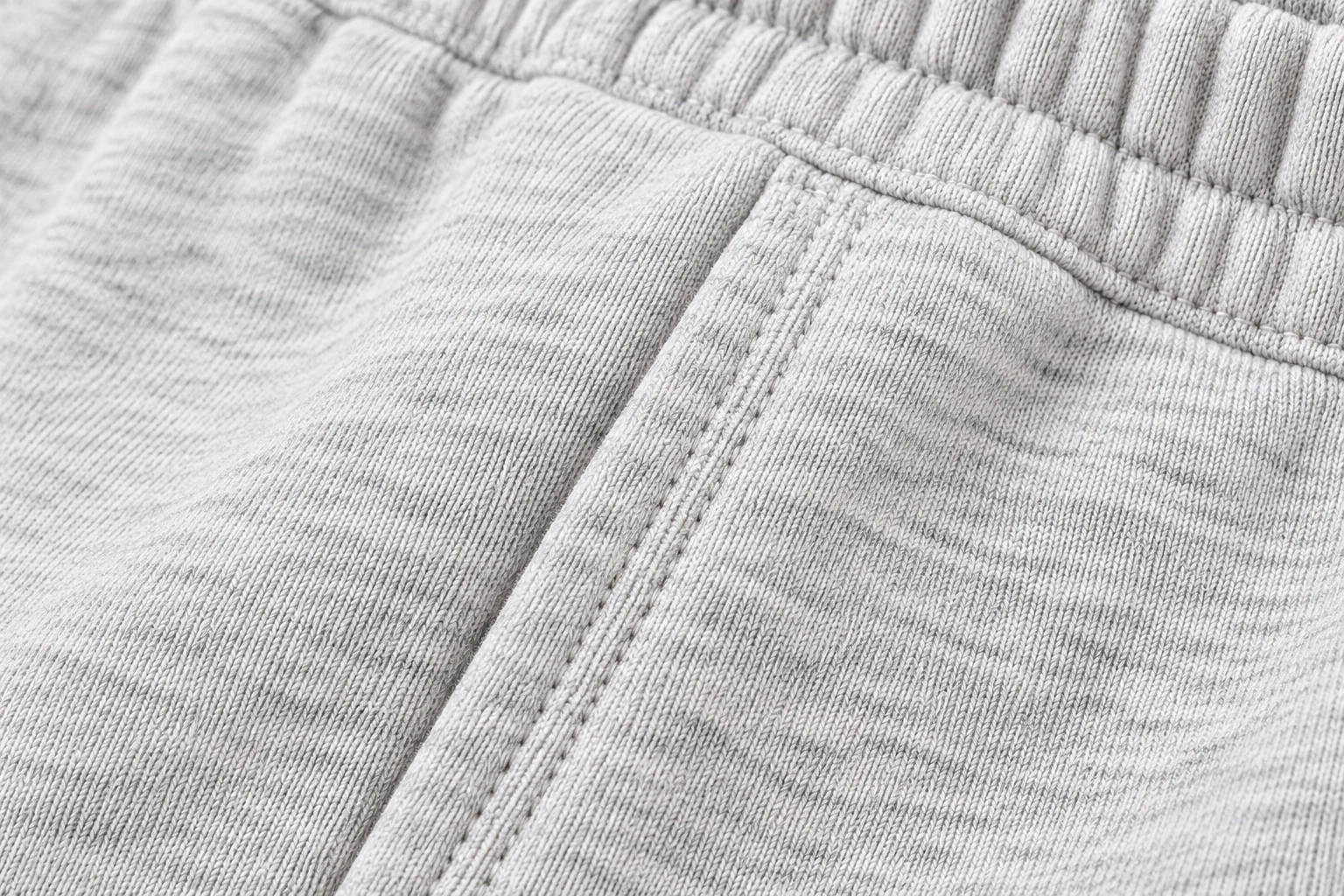
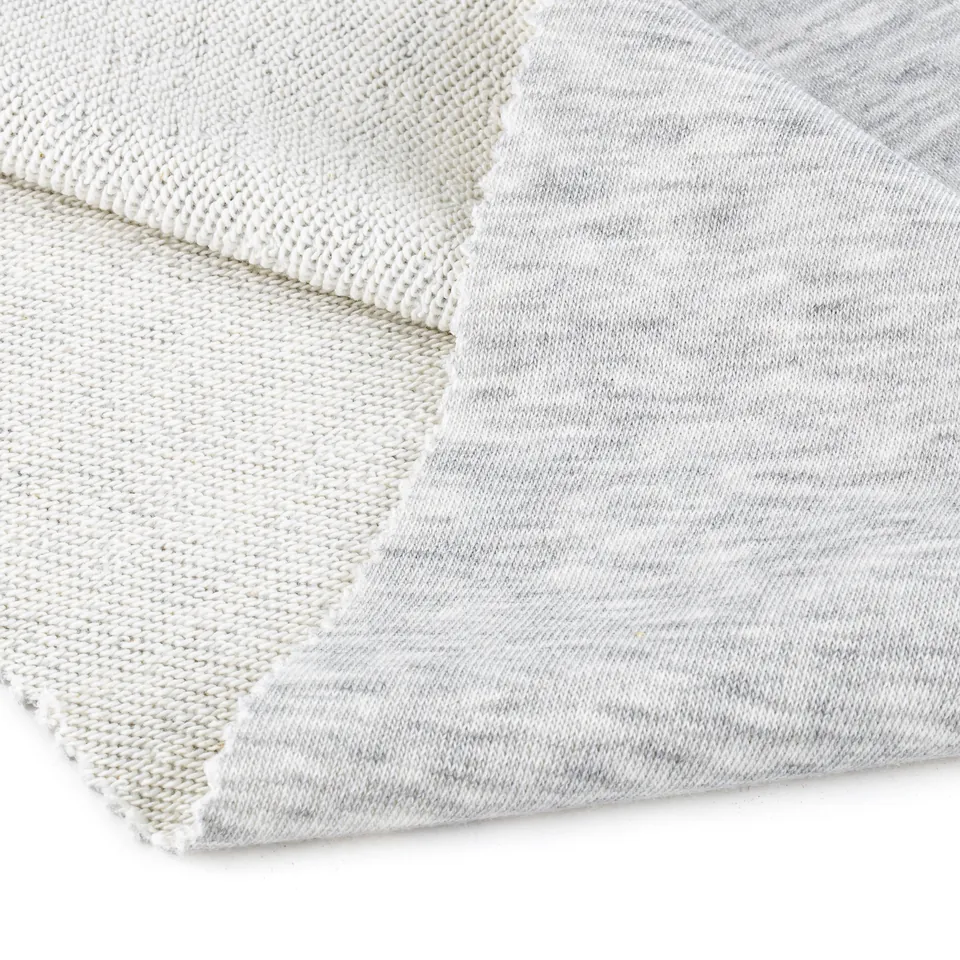
Review the bottom and its sweatshirt as different garments with one intention
Identify the actual top and bottom samples, size combination, patterns and intended paired silhouette. Record each garment's own measurements before reviewing the relationship around the sweatshirt hem and bottom waist. The purpose is not to demand identical dimensions or material behaviour from two different shapes. It is to establish whether the intended shade, handle and proportion remain acceptable together. Keep the sweatshirt reference fixed during the first bottom review so a change to its fit or component construction does not conceal which lower-garment proposal actually worked.
Name every material route in the comparison
FT-602 is 70% cotton and 30% polyester three-thread unbrushed material, unbrushed and compacted, with 300, 325, 350, 375 and 400 g/m² options. FT-601 is the same blend in two-thread unbrushed French terry with a silicone finish, at 240, 260, 280, 300 and 320 g/m². Record the precise offered option for each body, plus actual rib, waist and other components. Same composition does not establish equal stretch, recovery, handle or dimensional response. A substituted cutting or component needs identification before the sample's result can be attributed to the original proposal.
Observe the paired boundary without moving one piece to improve it
Photograph the top and bottom worn as intended, then review ordinary movement and sitting before the wearer readjusts either garment. Note whether the sweatshirt hem, bottom waistband and any visible drawcord or pocket meet the intended design relationship. If a concern appears, ask which pattern or component needs correction rather than changing both pieces at once. A bottom fit issue should not be hidden by lifting the sweatshirt for a photograph. Review relevant permitted size combinations rather than assume one matching size proves every pairing the programme may sell.
Separate handle observations from measured material claims
Compare the body and relevant components with their article, finish and preparation recorded. Ask reviewers to describe the perceived difference instead of replacing it with a broad label such as premium or inferior. A different hand can be an intentional product choice, while an unexpected difference in a repeat supply needs investigation. Neither an informal touch comparison nor a shared fibre percentage establishes recovery, strength or durability. Where the specification requires a measurable property, obtain relevant article-specific information and have the responsible specialist select methods and acceptance requirements.
Measure each garment through the same declared care comparison
Agree the care procedure, preparation and separate measurement landmarks for top and bottom. Track dimensions relevant to each: the sweatshirt's body and sleeves and the bottom's waist, rise and legs, with actual bands identified. AATCC lists garment dimensional changes and appearance after home laundering separately; a competent provider should confirm applicable current procedures and requirements. Keep uncared references where needed. The two shapes need not show the same numerical change, but the complete pair should be reviewed against the intended relationship after the defined procedure.
AATCC: Standard Test Methods and Procedures — Garment Care — Public index separates garment dimensional-change and appearance-after-home-laundering assessments. The paired review and mismatch investigation are original programme guidance, not a standard test protocol or proof of equivalent care response.
Investigate a changed pair without losing the baseline
If the cared or repeat bottom no longer looks right beside the top, retain both earlier references and the changed samples. Determine whether the observed issue is shade, shape, component balance or handle before selecting a corrective route. Record which article, finish, material group or construction actually changed. A shorter-looking leg after care calls for a different investigation from a similar-length bottom with another surface appearance. Do not ask for one unexplained fabric replacement to solve every discrepancy, and do not treat a general care observation as a guaranteed production-wide result.
Close the paired review with piece-level evidence intact
Record what was accepted for each garment and what was accepted about their relationship, with unresolved reports or samples clearly identified. Retain the actual top and bottom material, weight, finish, pattern and component references. A new bottom lot, altered rib or changed partner should trigger the relevant review rather than inherit approval by name. Purchasing and marketing need to understand which combination was observed and which measured results exist. The release should reproduce a documented tracksuit proposition without claiming identical stretch, permanent matching or care performance that the evidence has not established.
Technical background and scope
This is a structured editorial draft. Garment-specific development advice is paired with existing catalogue records; compatibility must be established by sampling. AL KUMAŞ supplies fabric. Cutting, sewing and finished-garment production are separate unless explicitly agreed.