






Cost the body after the broad opening is defined
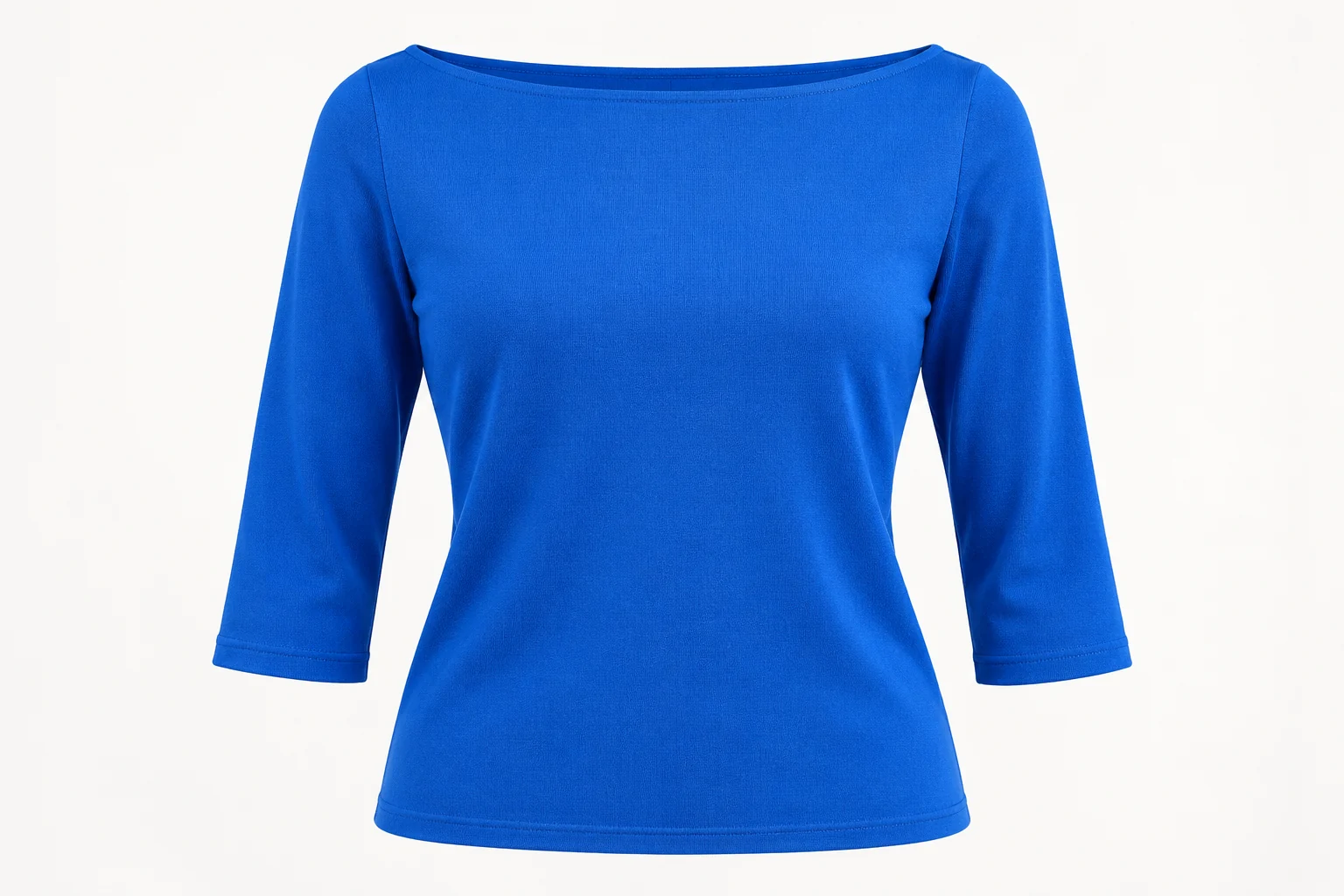
A wide neckline removes area from the front and back while introducing its own finishing components. Begin the consumption request with the actual boat-neck pattern, not a crew-neck estimate with an arbitrary deduction. Identify the front and back opening curves, shoulder construction, sleeve pieces where specified and hem treatment. Add bindings, facings or other edge materials according to the selected design. The cutter needs to know whether those components share the body roll or come from a separate supply. Otherwise a low estimate may simply omit the material that gives the neckline its finished form.
Make edge-strip dimensions a confirmed input
Ask the sample maker for the approved cut width, direction, length and joining rules of any separate neckline strip. The finished visible edge width is not enough to calculate its starting dimensions because folds and seam allowances depend on the construction. For a facing, use its actual pattern outline rather than treating it as a narrow rectangle. If the facing extends into the shoulder arrangement, show that extension in the component list. Keep support material separate where it is another substrate. These inputs should follow a sewn trial rather than an assumption that every broad opening uses one standard binding.
Understand a strip change before assigning savings
For an invented arithmetic example, consider a total strip length of 0.80 metres. A cut width of 0.03 metres gives 0.024 square metres; a cut width of 0.04 metres gives 0.032 square metres. At 200 g/m², the difference is 1.6 grams before losses or allowances. These are hypothetical component dimensions, not a boat-neck pattern, a finished edge specification or an AL KUMAŞ yield. The small mass difference cannot decide which construction lies acceptably. Its purpose is to show exactly what changes in a cost sheet when the maker alters a cutting dimension.
Ask what the shoulder shape permits in the marker
A broad opening changes the upper contours of both panels, but whether that helps nesting depends on the whole pattern and size ratio. CottonWorks describes marker planning as arranging garment pieces for efficient cutting; the boat-neck application requires the approved grain and face directions to stay visible. Do not assume that the neckline cut-out provides usable fabric for another component. Ask the cutter whether its dimensions and orientation meet the actual strip or facing requirements. An apparent scrap saving is not a sound estimate if it creates an unacceptable join or rotates a visible panel against the approved instructions.
CottonWorks: Garment Construction — marker making — Marker planning arranges pattern pieces for cutting and material utilisation. The strip-area and mass example uses explicitly invented dimensions and is not a verified boat-neck yield.
Catalogue starting points
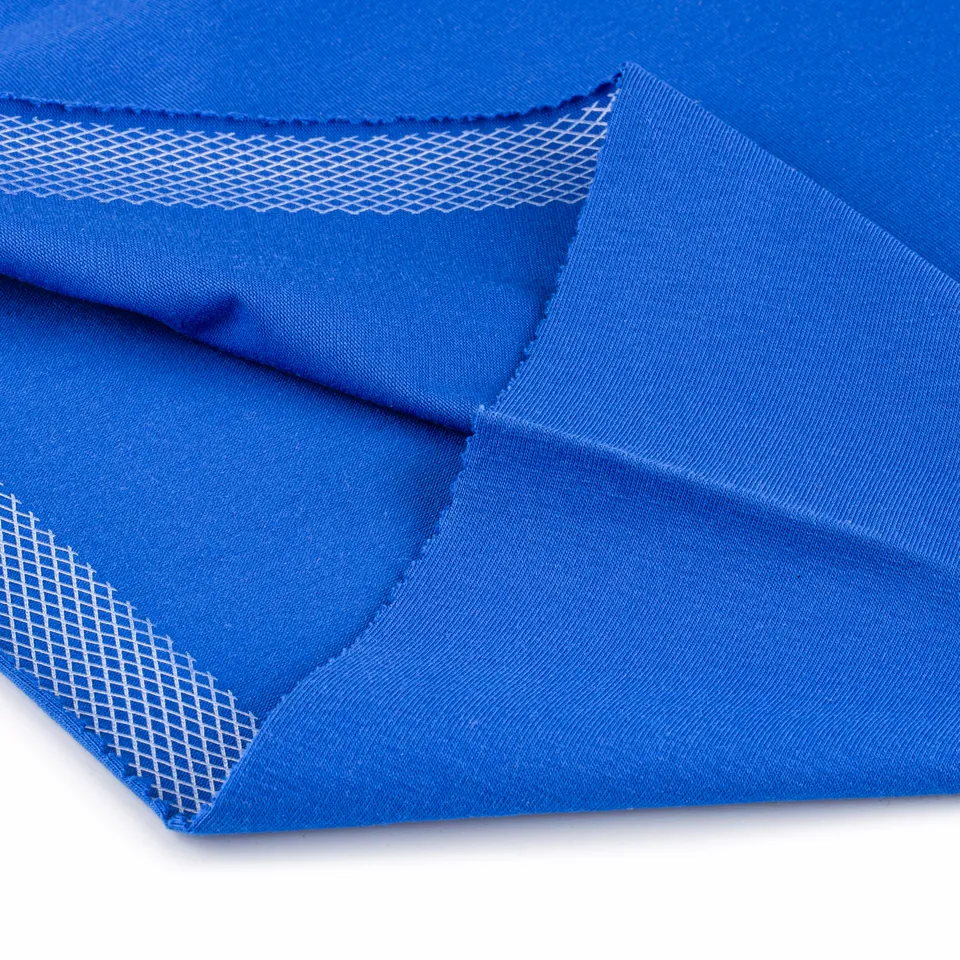
The recorded SJ-102 options are 170, 180, 190, 200, 210 g/m² for 95% cotton 5% elastane with Enzyme + compacted finishing. IN-202 is recorded at 220, 235, 250, 265, 280 g/m² for 92% cotton 8% elastane with Compacted + silicone finishing. Their listed weight ranges differ, so a direct purchasing comparison should identify the actual sample and intended top behind each offer. No verified usable width or boat-neck marker consumption appears in those records. Confirm the proposed specification and unit before converting a mass quotation into garment material cost.
Recalculate when the opening or shoulder changes
Raising a front opening, moving its endpoint or widening the covered shoulder can affect body area, facing shape and edge length together. Have the pattern technician issue those revised components explicitly. An early consumption total should not survive unchanged merely because the style still has the same name. Identify any dimensional compensation already built into the pattern and keep it distinct from marker inefficiency and purchasing buffers. A material comparison based on two different revisions is not equivalent; label the assumptions and decide which approved geometry is being costed for each route.
Price a complete finishing route
Add the edge-material supply, support where specified and finishing operations to the body-material comparison. A more complicated facing can change assembly work without adding much mass, while a separate purchased strip may carry its own minimum or price basis. Ask the garment maker to make those differences visible rather than placing them inside an unexplained general allowance. Present the accepted size mix, marker revision and offered body dimensions beside the total. This lets the buyer judge the actual boat-neck construction instead of choosing a kilogram price that excludes the opening's defining work.
Technical background and scope
This is a structured editorial draft. Garment-specific development advice is paired with existing catalogue records; compatibility must be established by sampling. AL KUMAŞ supplies fabric. Cutting, sewing and finished-garment production are separate unless explicitly agreed.