



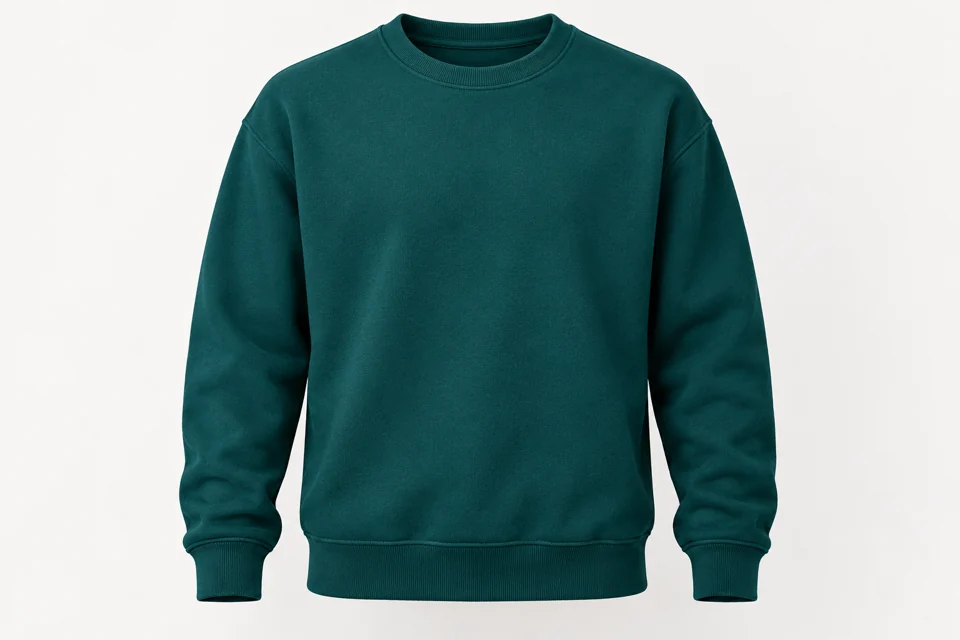


Translate a sweatshirt shape into a material cost
The plain appearance of a crew-neck sweatshirt can conceal important costing differences. A wider body, deeper cuff and separate lower band alter consumption even without decoration or pockets. Ask for the actual pattern revision and size ratio before comparing fabric offers. Identify whether the neckband, sleeve cuffs and hem band use separate rib, because their cost should not disappear into an unexplained body-fabric allowance. A clear component split helps purchasing understand which design change caused a revised cost instead of attributing everything to a heavier fabric.
Compare offered weights rather than family labels
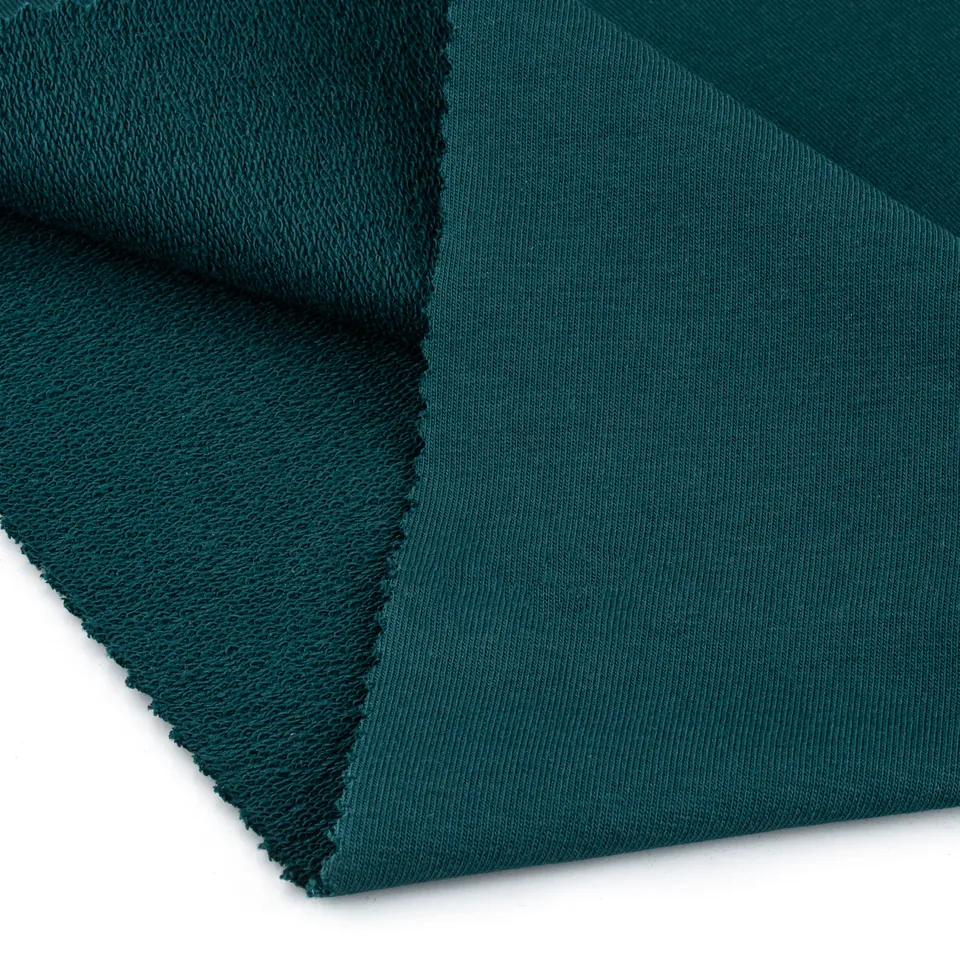
The local FT-601 record lists 240, 260, 280, 300 and 320 g/m², while FT-602 lists 300, 325, 350, 375 and 400 g/m². Both state 70% cotton and 30% polyester. Ask the supplier to identify the specific finished-weight offer and tolerance. Do not substitute the word heavyweight for that information. If you want to understand a construction or finish difference, the common 300 g/m² entry could provide a discussion point, but equivalent nominal weight does not guarantee equivalent thickness, stretch or handle. Their construction and finish records also differ: FT-601 is two-thread, unbrushed silicone; FT-602 is three-thread, unbrushed compacted. Keep those variables on the comparison sheet.
Give width a place beside every price
Usable width is not verified in these catalogue entries. Request the supply format and the width available for the marker, with any excluded edges identified. The cutting room should establish whether the largest body and sleeve pieces can be arranged efficiently at that width. An oversized sweatshirt may behave differently in the marker from a narrow fitted one even if their flat fabric area seems similar. If a quotation changes width, ask for an updated cutting assessment rather than retaining the old consumption factor automatically.
Use a worked example with visible assumptions
Consider a hypothetical open-width material at 280 g/m² and 1.70 metres usable width. Its theoretical mass per linear metre is 280 multiplied by 1.70, or 476 grams. If a representative sweatshirt marker allocates 1.20 linear metres per garment, that allocation represents 571.2 grams of body fabric. At an illustrative price of 6 currency units per kilogram, the theoretical body-material cost is about 3.43 units. These widths, marker consumption and price are invented teaching inputs, not AL KUMAŞ offers or predictions for your sweatshirt.
Add rib and allowances without counting them twice
The example excludes separate rib, development charges and any additional purchasing allowance. Have the maker state neckband, cuff and lower-band consumption independently, using the units in which those materials will actually be bought. Establish whether pattern allowances already accommodate the agreed dimensional behaviour. CottonWorks explains that construction, processing and garment care affect dimensional change, but it gives no shrinkage value for these FT articles. Do not apply a guessed universal percentage, then add another hidden allowance for the same issue elsewhere in the spreadsheet.
CottonWorks: Shrinkage & Skewing — Construction, processing and care influence dimensional change. It supplies no shrinkage percentage for FT-601 or FT-602 and does not validate the explicitly hypothetical cost example.
Test the cost effect of a design revision
Suppose the designer lengthens the lower band while keeping the body drawing unchanged. Ask whether the finished overall length stays constant or increases; the pattern team may need to shorten the body rather than simply adding rib. Likewise, a broader neckline can alter both the body pattern and band requirement. Request a revision note showing which components changed and whether a new marker was made. This allows the team to challenge a consumption increase constructively instead of negotiating the kilogram price to compensate for an unexplained pattern change.
Release the costing with its material identity
The final comparison should name the article, finished weight, confirmed usable width, pattern version, size ratio and separate component costs. Show the theoretical conversion and the marker result as different calculations. Confirm the commercial quantity, currency and delivery terms with the supplier before relying on the final figure. When a subsequent order changes fit, size distribution or fabric width, reopen the relevant assumptions. A repeat sweatshirt name is not enough evidence that last season's material consumption still applies to the revised programme.
Technical background and scope
This is a structured editorial draft. Garment-specific development advice is paired with existing catalogue records; compatibility must be established by sampling. AL KUMAŞ supplies fabric. Cutting, sewing and finished-garment production are separate unless explicitly agreed.