



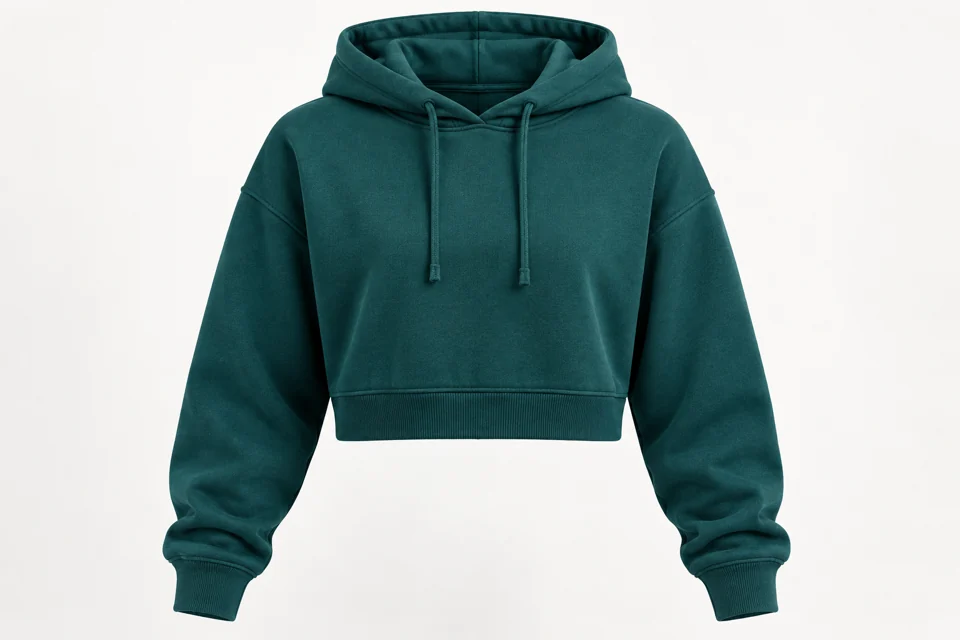


Assess the hood and short body as a relationship
A cropped hoodie can retain a substantial hood while removing length from the body beneath it. The resulting design needs its own balance review rather than approval as a shortened standard hoodie or a cropped sweatshirt with a hood attached later. Draw the intended adult crop position and the full hood in both raised and resting states. Decide whether front and back lengths differ deliberately. The material discussion should answer how that actual configuration behaves, not assume that a soft cutting or a heavier body will automatically keep the short silhouette in place.
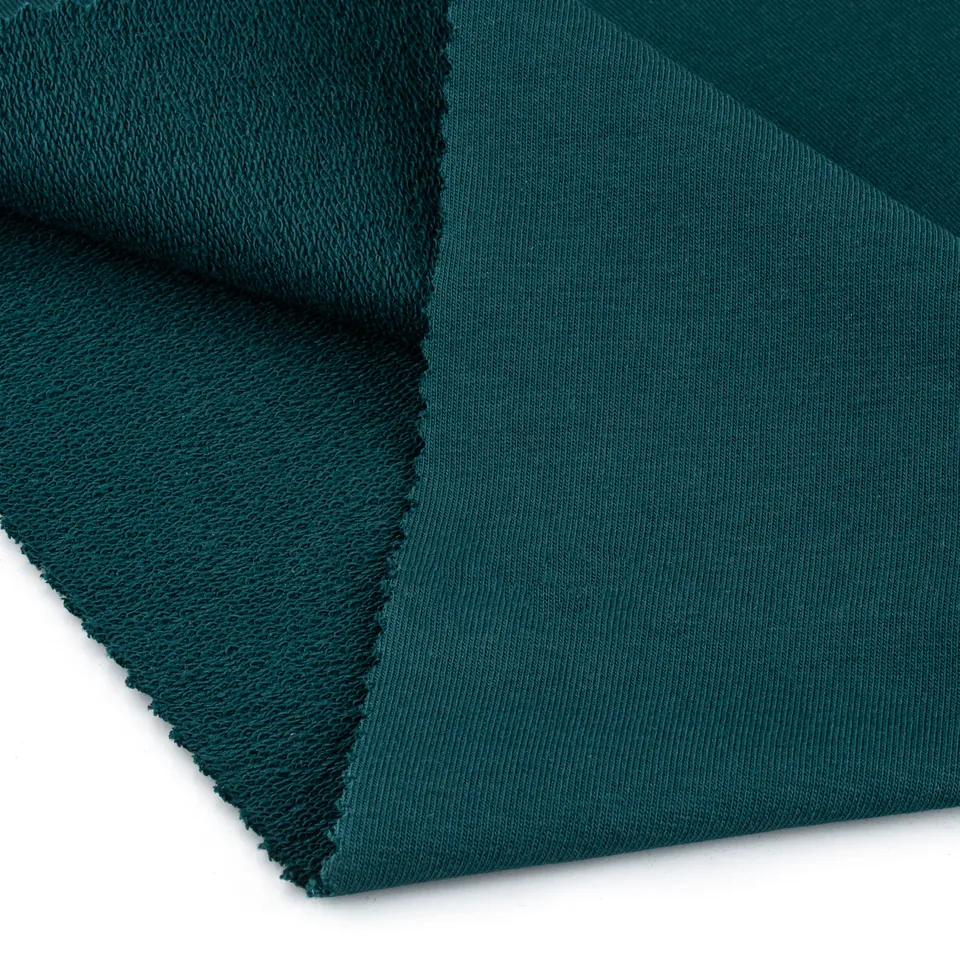
Compare the recorded unbrushed constructions
FT-601 is seventy percent cotton and thirty percent polyester, two-thread French terry with unbrushed silicone finishing, at 240, 260, 280, 300 and 320 grams per square metre. FT-602 has the same blend in three-thread unbrushed compacted material at 300, 325, 350, 375 and 400 grams per square metre. Both include a 300 gram option, but their construction and finish labels still differ. Request the actual offered sample. Neither catalogue entry establishes hood stability, warmth, recovery or tested coverage for this short-body garment.
Sew the hood at its intended complete size
Build the actual outer hood, inner layer and neck attachment rather than testing a scaled-down hood or a single unfinished layer. Attach it to the short body pattern that the collection intends to use. Observe whether the resting hood changes the front opening, back neck or crop position on the wearer. If it does, identify the relevant pattern and component question with the developer. A different inner layer can be investigated, but it should remain an explicit material choice with a new sample, not an invisible substitute that makes the original route appear successful.
Compare hood-up and hood-down views without resetting the hem
Let the wearer raise and lower the hood, then observe the body and hem in their normal positions before rearranging them. Record whether the front or back lifts, whether the neckline shifts and whether the garment returns to the intended crop. A single posed photograph can conceal this transition. Do not treat a tighter lower band or extra material weight as a universal counterbalance. Ask the developer to distinguish hood geometry, neck attachment, body pattern and band behaviour before selecting the next controlled change.
Resolve the neck junction over the actual underlayer
Inspect the hood-base seams and any support on the intended adult outfit layer. The cropped body may leave less material between neck and lower band, but that fact alone does not predict how the seam will feel or the garment will settle. Coats distinguishes seam component arrangement from stitch choice; identify the complete attachment and inspect it inside and out. If the junction becomes bulky, compare a documented construction revision. Do not assume the maker can remove or add layers without affecting the hood and body relationship already being assessed.
Coats: Seam Types — Seam component arrangement and stitch choice are distinct. The proposed neck-junction review is original garment-development guidance, not a proven counterbalance method, sewing specification or comfort result.
Choose the lower edge with the hood still attached
Evaluate the intended hem or rib construction standing, seated and during agreed reaching movements with the full hood present. A band approved on a hoodless crop does not automatically reproduce its behaviour here. Check whether the body gathers as intended and whether the short front remains visually balanced against the back. Record the garment and styling reference instead of making a universal coverage claim. If changing band depth or grip is proposed, review its relationship with body length and the hood transition rather than approving the component from its flat cutting alone.
Select a complete cropped-hoodie configuration
Compare the offered routes using identified hood layers, short body pattern, lower edge and representative adult sizes. Record which result came from material, pattern or assembly and which technical questions remain open. Retain the physical garment and component references together before commercial acceptance. Request relevant care and performance evidence separately; an appealing initial fit does not establish permanent recovery, thermal benefit or guaranteed crop position. A later hood-lining or body-finish change should return to the affected balance observations even if the main article name stays familiar.
Technical background and scope
This is a structured editorial draft. Garment-specific development advice is paired with existing catalogue records; compatibility must be established by sampling. AL KUMAŞ supplies fabric. Cutting, sewing and finished-garment production are separate unless explicitly agreed.