



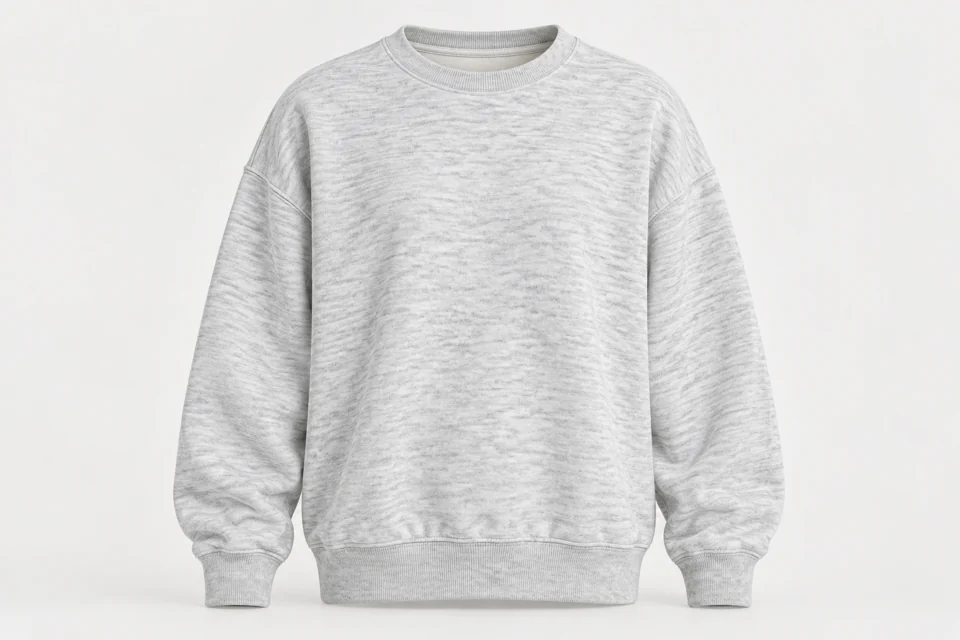


Place artwork against the actual upper-arm join
A dropped sleeve seam changes the visible boundary between body and sleeve, even when the sweatshirt is one colour. Decide whether the graphic should remain entirely on the body, sit on the sleeve or cross that join intentionally. Use the actual pattern rather than a conventional shoulder reference. A logo positioned on the outer sleeve of one style can appear farther down the arm when transferred unchanged. Show front, side and back placements so the decorator can understand the intended worn view instead of guessing from a flat front mock-up.
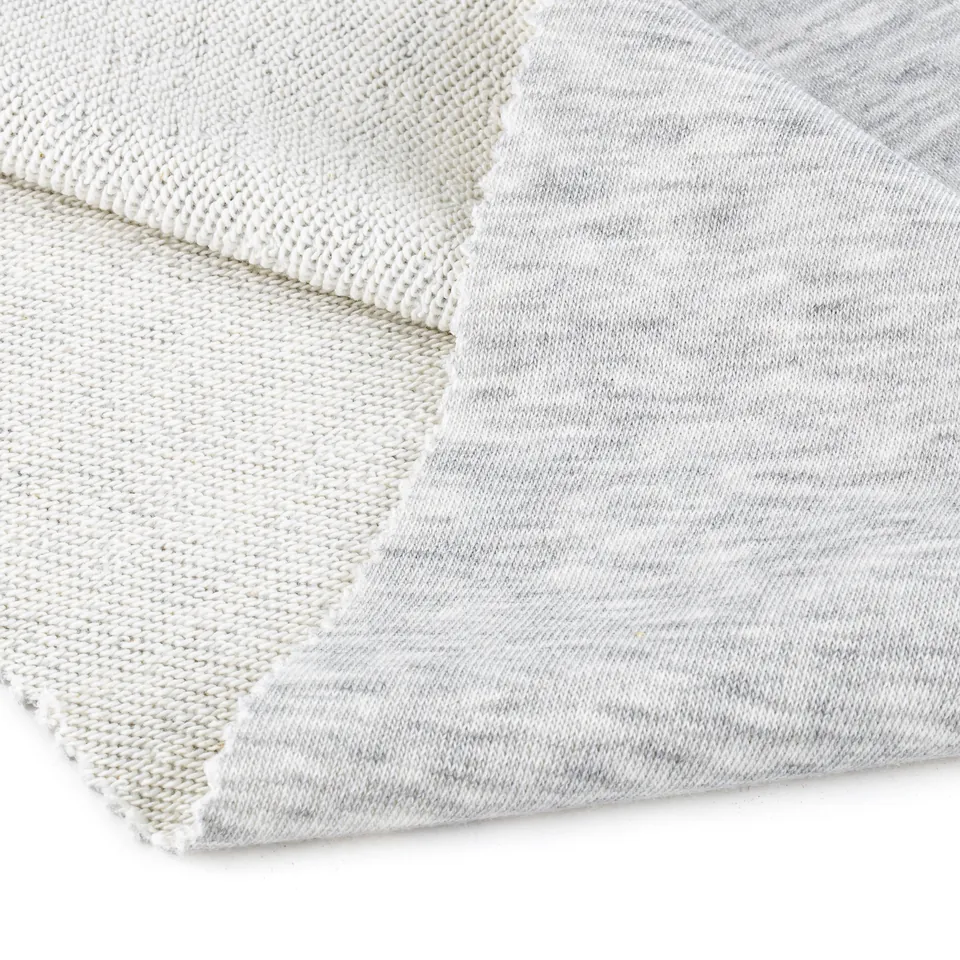
Identify the surface that carries the colour and artwork
The proposed FT-602 route is seventy percent cotton and thirty percent polyester, three-thread unbrushed compacted material, at 300, 325, 350, 375 or 400 grams per square metre. FT-601 is two-thread unbrushed silicone French terry in the same blend at 240, 260, 280, 300 or 320 grams per square metre. Record the offered weight and finish with the sample. Equal blend content or a common nominal weight does not establish an identical surface, transferable shade approval or the same decoration behaviour between these two constructions.
Decide whether a contrast sleeve emphasises the seam
A contrast sleeve makes the dropped join an explicit colour boundary. Assess where that boundary sits on representative adult sizes and whether the front and back colour fields remain balanced. Identify whether the sleeve uses another colour of the body article or a different material route. The latter needs an actual paired-material trial, not only coordinated colour names. Include the cuff and lower band in the plan so their colour relationship is deliberate. A small accepted sleeve cutting does not define the appearance of a full lowered shoulder panel.
Choose placement rules that survive grading
Ask the designer whether artwork is measured from centre front, neckline, the dropped join or another defined reference. A rule based on one pattern point may move a graphic differently from a rule based on another as sizes change. Review the intended range before selecting a fixed motif or scaling approach. If a design crosses the join, ask the maker and decorator to assess alignment and application order. Do not promise uninterrupted artwork simply because the digital image omits the seam allowance and shows an idealised flat surface.
Qualify the decorated join as an assembly
CottonWorks explains that fibre content and fabric surface influence printing choices. Request the actual application on the offered material, including any backing or support, rather than assuming a generic cotton-rich process is sufficient. For decoration near the join, inspect local stiffness, folding and the inside construction with the arm relaxed and moving. An added backing can become another component at the very junction being assessed. These are development observations, not confirmation of a process offered by AL KUMAŞ or evidence of a tested decoration result.
CottonWorks: Cotton Textile Printing Basics — Fibre content and fabric surface influence printing choices. Trials at the dropped sleeve join are original development advice, not confirmed application compatibility or an AL KUMAŞ decoration service.
Review the visual line after ordinary movement and care
Photograph the accepted placement with the wearer in the agreed resting and movement positions, then reassess through the defined care trial. CottonWorks includes cleaning-related appearance in quality evaluation; the general source supplies no result for this decorated sweatshirt. Keep graphic appearance, seam line and body dimensions as separate observations. A mark that rotates with sleeve twist may call for a pattern investigation rather than a different print position alone. Ask the responsible team to identify the cause before approving an adjustment that merely hides the symptom in one pose.
CottonWorks: Quality Testing — Quality evaluation includes cleaning-related appearance effects. It supplies no decorated-garment result or reason to attribute a rotating graphic to one untested cause.
Release the seam-aware visual specification
Retain the actual panel colour references, offered material identities, artwork dimensions and placement rules by size. Include the sleeve join construction where it affects the application. Record any accepted discontinuity or contrast deliberately, so a production team does not try to correct an intentional design choice. If the shoulder extension, sleeve pattern or cuff changes later, review the artwork relationship again. A repeat shade name and unchanged image file do not by themselves reproduce the approved drop-shoulder sweatshirt presentation.
Technical background and scope
This is a structured editorial draft. Garment-specific development advice is paired with existing catalogue records; compatibility must be established by sampling. AL KUMAŞ supplies fabric. Cutting, sewing and finished-garment production are separate unless explicitly agreed.