





Define the deeper chest opening through its drawing
Half zip and quarter zip are commercial descriptions, not precise instructions for an opening length. This brief concerns a sweatshirt whose planned opening extends farther into the chest panel, where its termination and support need to work with the moving body. Draw the actual endpoint and the intended opened shape. If the proposed design uses the same opening as another style, its name alone creates no new engineering requirement. The useful distinction is the real chest-panel assembly, not an assumed fraction of overall garment length.
Compare the substantial brushed and unbrushed offers
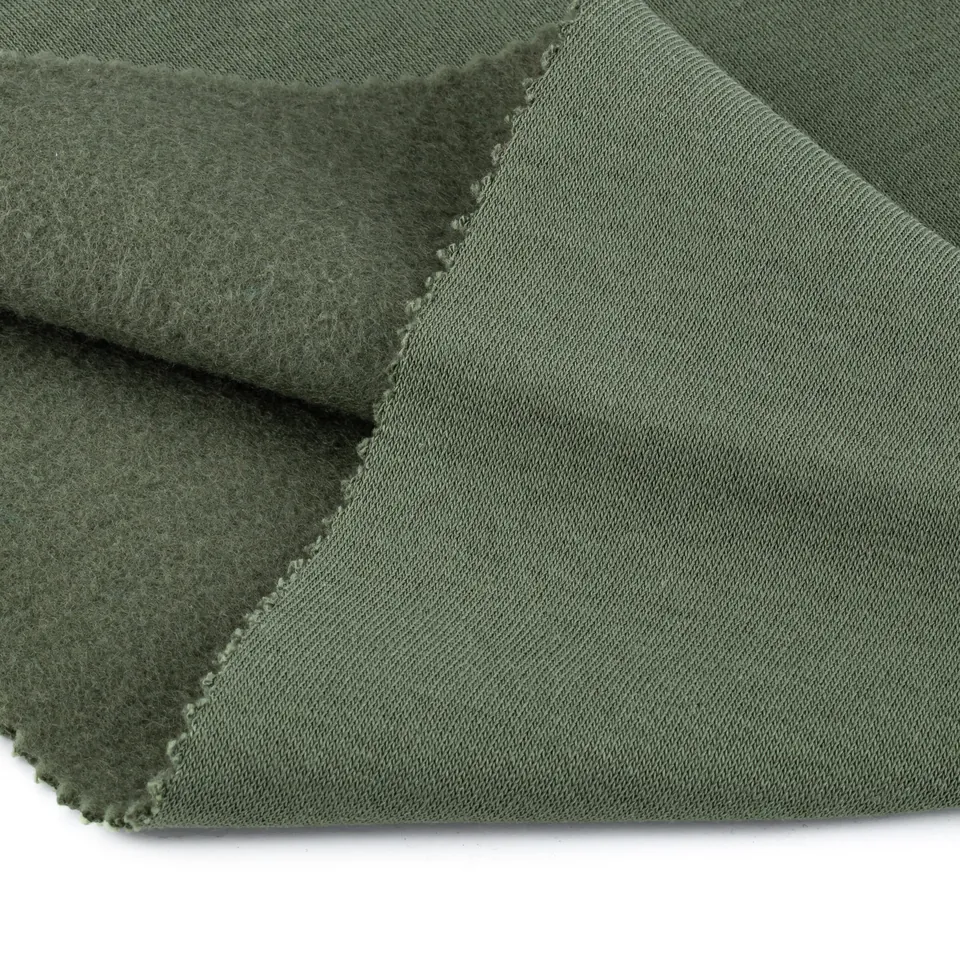
FT-603 is three-thread brushed fleece, sixty-five percent cotton and thirty-five percent polyester, with a brushed anti-pilling designation at 320, 345, 370, 395 and 420 grams per square metre. FT-602 is seventy percent cotton and thirty percent polyester, three-thread unbrushed compacted material, at 300, 325, 350, 375 and 400 grams per square metre. Ask for the exact offered option. These routes differ in blend, finish and listed weights, so the sample comparison cannot establish a finish-only effect. The anti-pilling description is not a test score.
Trial the lower termination in a full chest panel
Ask the maker to demonstrate the chosen opening end with its real facing, support and seam allowances. Retain enough surrounding front panel to assess its relationship with the body, rather than inspecting a tiny isolated corner. Observe the termination while the wearer sits and reaches with the zip partly lowered. If the area forms an unwanted ridge or pulling line, identify the construction question with the developer. Selecting a thicker body to hide an unresolved insertion can change the whole garment without explaining the cause of the original problem.
Judge support along the deeper edges rather than only at the neck
Compare how the opening edges lie against the surrounding chest when fastened and opened. State whether the desired result is firm and defined or more fluid, then assess the actual supported assembly. Coats identifies tension, feeding and component differences among contributors to puckering. That general context supports a controlled investigation rather than a conclusion that the body fabric alone failed. Ask the technician to document the support and sewing used. More reinforcement is not an automatic improvement if it creates an overly rigid strip or another intrusive layer.
Coats: Eliminating Seam Puckering — Tension, feeding and component differences can contribute to puckering. The supported deeper-edge comparison is original development guidance, not an approved support or sewing setting for these articles.
Resolve collar layers where the zip enters the neckline
The upper intersection still needs the actual collar, inner finishing and fastener tape, but it should not distract from the longer front assembly below. Examine the top with the collar raised and folded as the design intends. If the junction is bulky, ask the maker and fastener specialist to agree the component arrangement. YKK's instruction manual warns that trimming tape can damage it; apparent excess is not permission to cut it arbitrarily. The manual is general reference information, not approval of a particular fastener for this sweatshirt.
YKK: Zipper Usage Instruction Manual — The manual's tape-trimming precaution explains that cutting tape can damage its structure. It is reference guidance, not confirmation that a YKK component is specified or suitable here; current component-specific advice remains necessary.
Compare inside contact and the open-front fall
Wear the representative sample over the intended adult layer and inspect the facing and support when the deeper opening spreads. Record which inside areas become visible and where the termination rests against the body. A brushed reverse or an unbrushed finish can be discussed through the actual samples, without claiming either guarantees comfort or warmth. If the maker substitutes a facing or lining during development, label it before interpreting the result. The body code alone cannot reproduce the open-front feel and appearance of that complete assembly.
Choose the assembly that resolves the defined chest-panel question
Compare the material routes using the same actual opening endpoint, fastener identity and agreed movement observations wherever practical. Record whether the accepted result required a pattern, support or sewing revision rather than attributing it vaguely to better fabric. Retain the completed front assembly with the body offer and component list. Appropriate care and technical evidence remain separate requirements. A clean closed line on a mannequin does not establish operation, post-care compatibility or durability, especially when the real design extends the opening into a different part of the chest.
Technical background and scope
This is a structured editorial draft. Garment-specific development advice is paired with existing catalogue records; compatibility must be established by sampling. AL KUMAŞ supplies fabric. Cutting, sewing and finished-garment production are separate unless explicitly agreed.