




Establish the floor-clearance reference before fitting
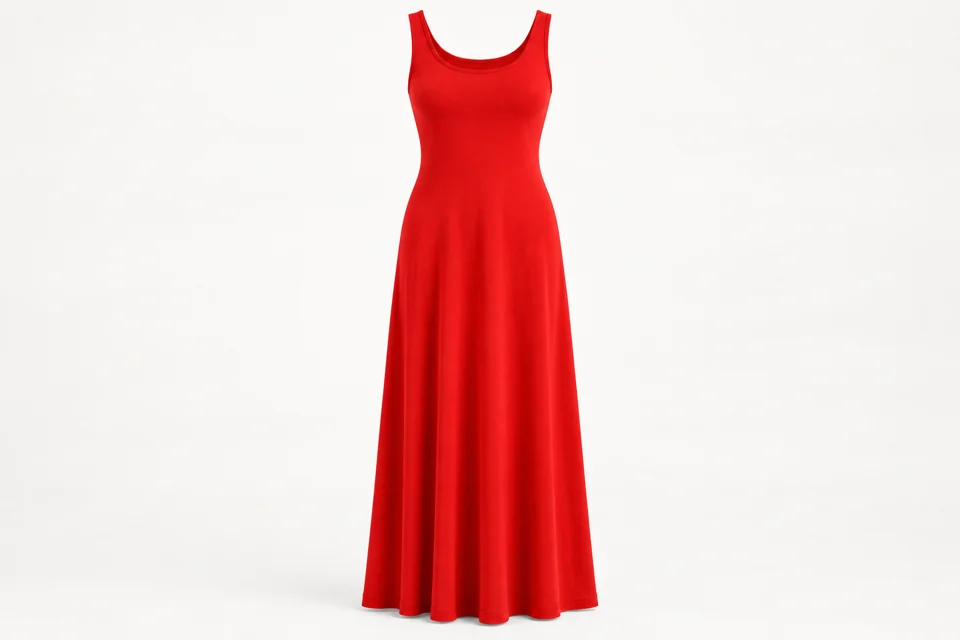
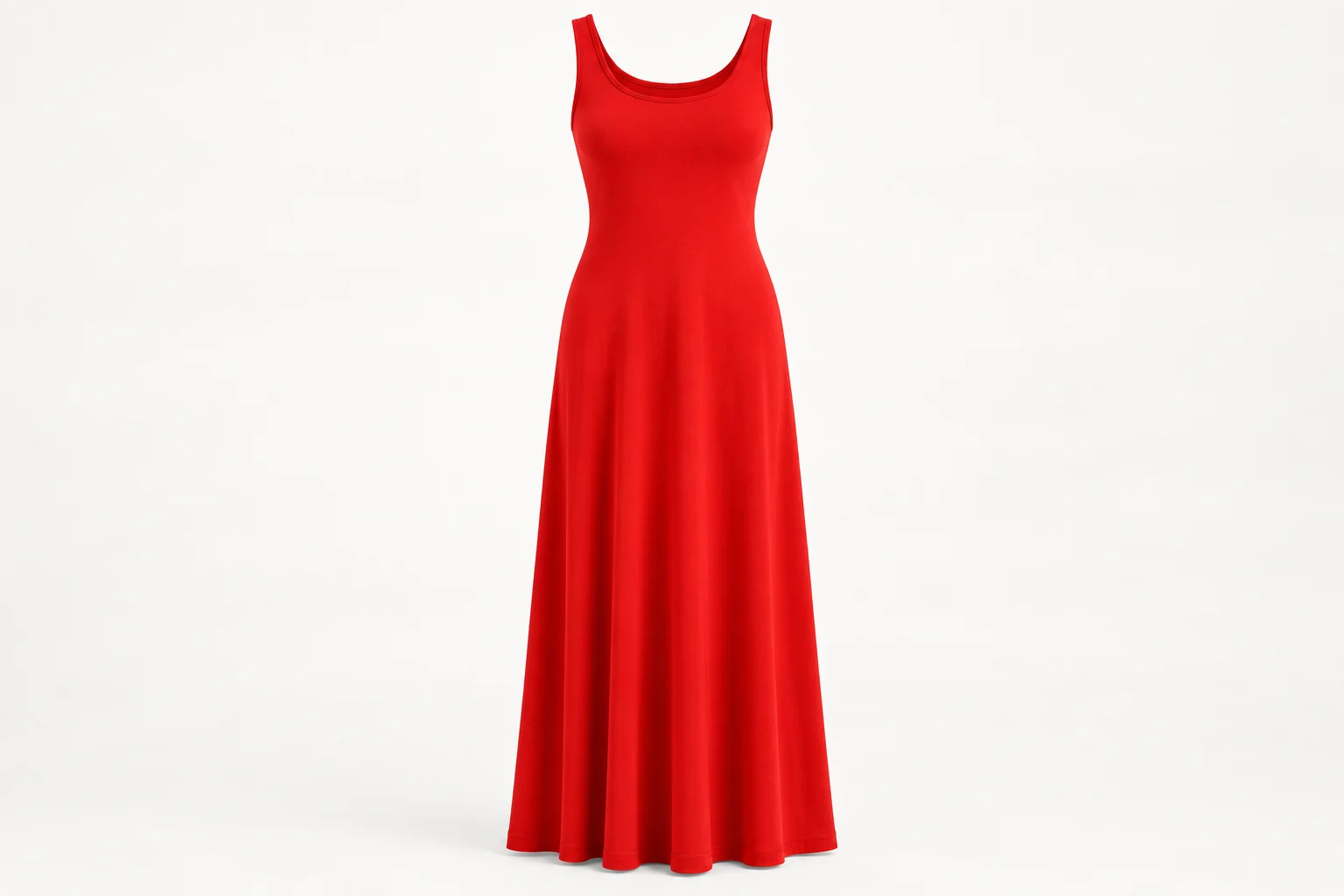
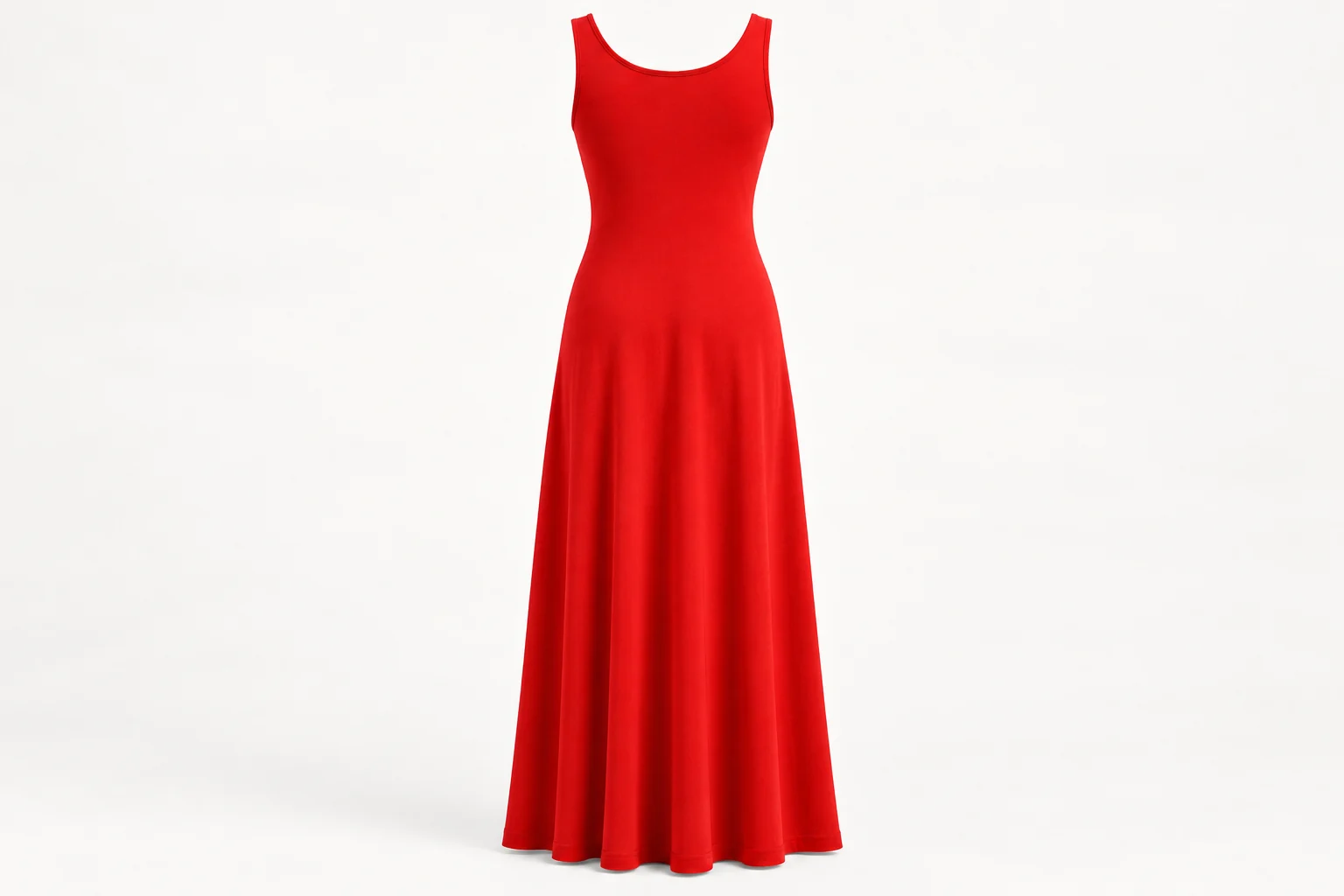
Identify the sample's body article, offered weight, finish, pattern and full dress length, then record the wearer reference and intended footwear. Mark the hem position used for assessment and photograph the garment without lifting or stretching it to create a preferred line. A maxi sample reviewed barefoot cannot automatically represent a brief developed around another shoe. If a lining or walking opening is specified, it must appear in the review record. These boundaries make later comments about length or movement meaningful instead of allowing different styling conditions to masquerade as material change.
Observe the shoulder under the complete garment
Inspect the neckline, shoulder seam and any actual support with the dress carrying its intended full-length body. Compare front and back position after the agreed observation period rather than deciding from a cropped upper prototype. Do not invent a universal hanging duration or presume that the material will necessarily grow. If a change is observed, record its location, amount where measured and assessment conditions. Ask the pattern and sewing teams whether another assembly or balance trial is needed. Keep the full sample available so the upper-body correction can be evaluated together with the lower silhouette.
Check walking clearance without adjusting the hem by hand
Use ordinary walking, turning and seated movements chosen for the intended design, with the same footwear and layer arrangement. Observe whether the hem reaches an unintended position or the lower panel restricts the proposed stride. If the sample requires frequent lifting to perform an ordinary intended movement, identify that finding for the developer instead of treating it as styling. Assess any specified slit or opening as constructed. A stretch-containing fabric is not proof that an arbitrarily narrow or long panel will meet the brief, and this review does not establish a universal clearance guarantee.
Inspect long seams and any lining relationship
Review side seams along the whole panel, not only at the upper body. Record waviness, rotation or a lining that pulls the outer layer into an unwanted shape, and identify the actual components involved. Coats describes seam appearance as potentially influenced by feeding, tension and component behaviour; use that background to plan a controlled assembly comparison rather than a universal machine adjustment. If the lining is shortened or its attachment changed, repeat the affected walking and hanging observations. The acceptance concerns the assembled long garment, not merely a well-finished seam sample in isolation.
Coats: Eliminating Seam Puckering — Feeding, tension and component behaviour can affect seam appearance; supports controlled investigation, not a universal machine adjustment.
Catalogue starting points
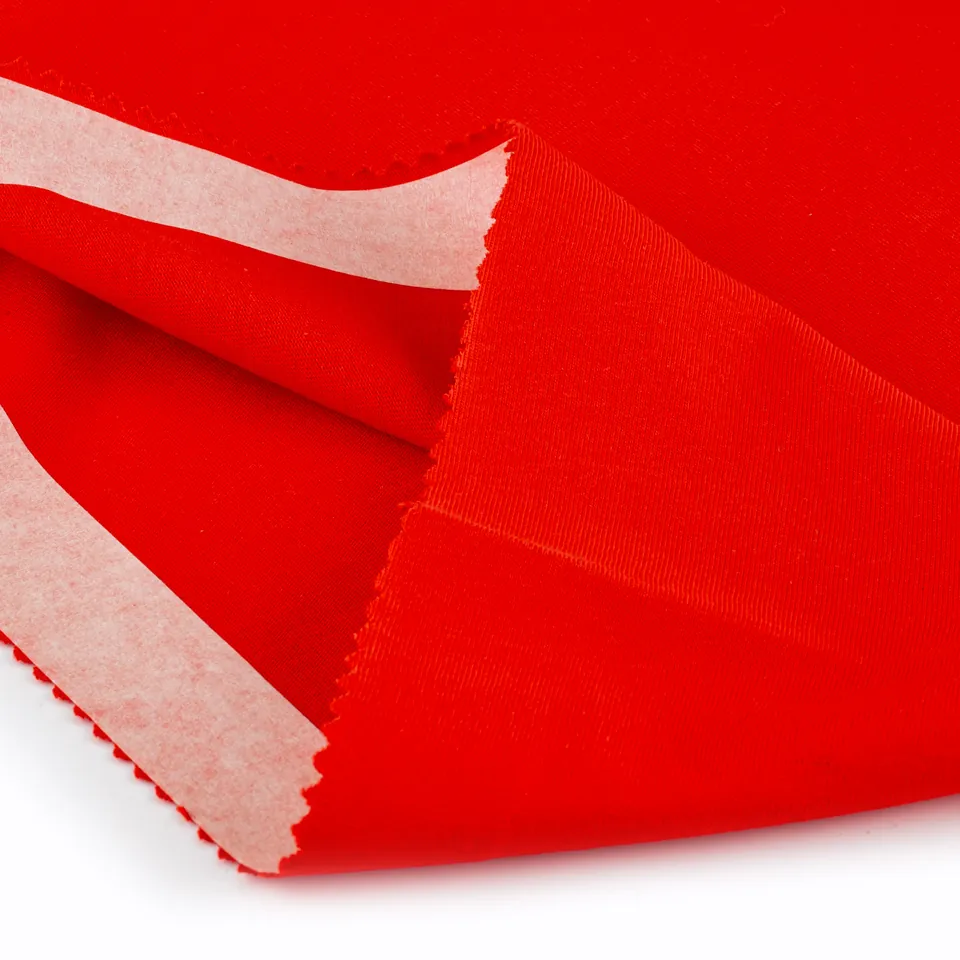
SJ-103 contains the recorded 95% viscose 5% elastane blend at 160, 170, 180, 190, 200 g/m² with Bio-polish + silicone finishing. SJ-104 records 95% modal 5% elastane at 150, 160, 170, 180, 190 g/m² with Bio-polish + soft hand finishing. Neither entry supplies maxi-dress shoulder-growth, drape, opacity or care-clearance results. Keep the specific trial weight and finish named, including provisional substitutions. The modal designation and soft-hand wording do not replace the measured and observed behaviour of the actual full-length sample.
Repeat dimensional and wearing observations after agreed care
Agree the care procedure and measurement conditions with the quality team before exposure. Record relevant shoulder and body lengths, seam positions, hem measurements and any inner-layer dimensions. CottonWorks identifies dimensional stability as relevant to fit and appearance, which explains why a care review should return to the full worn dress rather than stop at a ruler reading. Reassess floor clearance using the original footwear and fastening or layer conditions. Ask the responsible specialist to interpret changed dimensions and set appropriate criteria; no catalogue finish label provides a universal allowable length change.
CottonWorks: Quality Testing — dimensional stability — Dimensional stability relates to fit and appearance. Does not give a care-clearance or growth result, test criterion or stability guarantee for this maxi dress.
Approve a length-and-construction configuration
Close the sample record with each accepted observation and unresolved question, identifying which revision requires another check. An illustrative maxi might show the intended initial hem position but a changed shoulder relationship after care; approval of its first photograph would not resolve that finding. Retain the earlier and revised samples together and state which lengths, colours and representative sizes were assessed. A subsequent length option, lining or body substitution needs a decision about repeated evaluation. The release should document the demonstrated dress configuration while leaving untested drape, stability and coverage properties unclaimed.
Technical background and scope
This is a structured editorial draft. Garment-specific development advice is paired with existing catalogue records; compatibility must be established by sampling. AL KUMAŞ supplies fabric. Cutting, sewing and finished-garment production are separate unless explicitly agreed.