



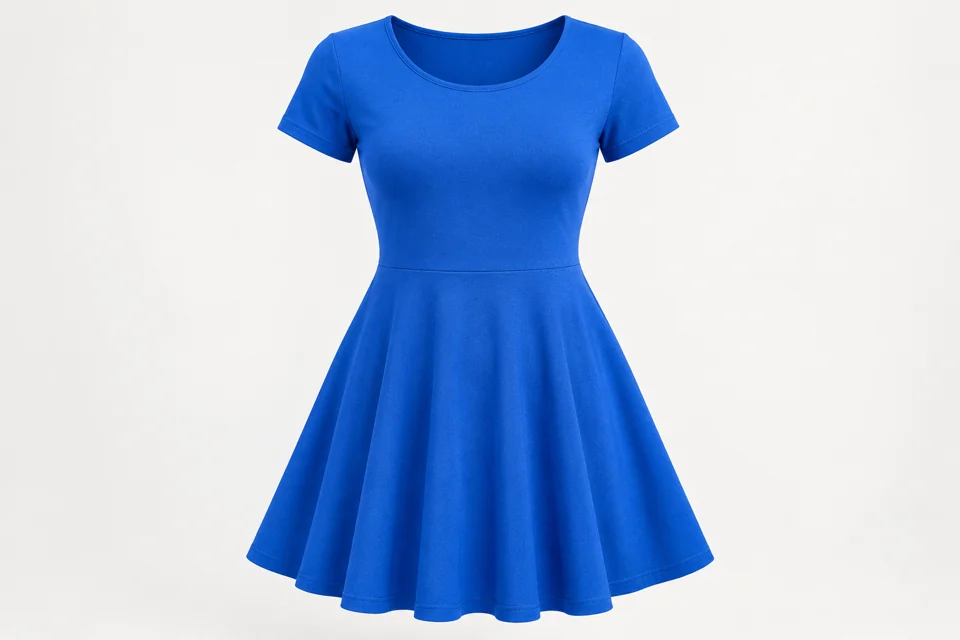
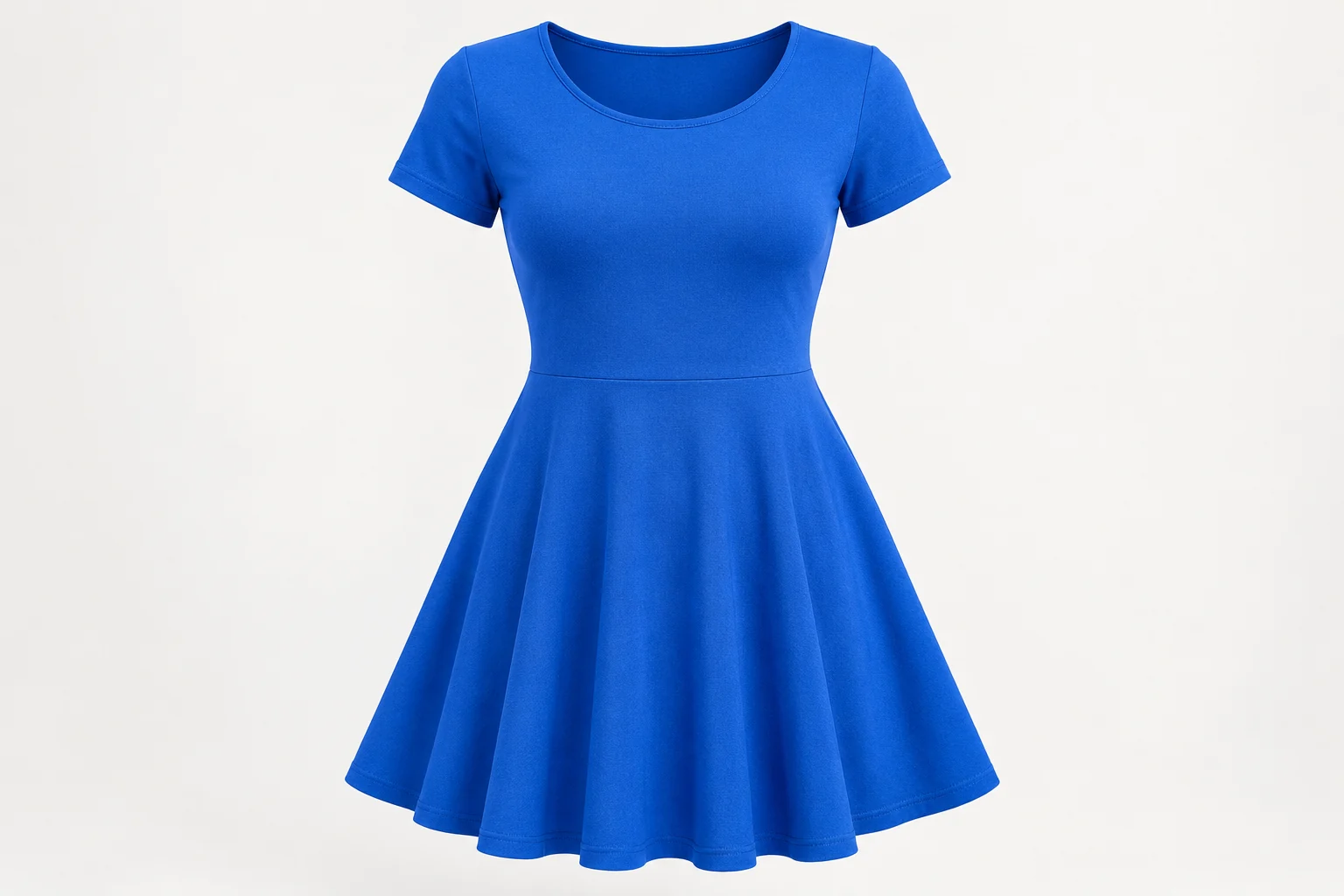


Identify the fitted upper and flared lower pattern together
Label the sample's body article, offered weight, finish, size, bodice and skirt pattern references and waist position. Include the actual skirt construction, seam, hem treatment, neckline finish and any lining or support specified. A temporary skirt joined to an approved bodice does not qualify the intended complete dress. The review should show where the fitted upper section ends and how the lower flare is attached. This lets comments about waist pressure, panel appearance or skirt movement be traced to the assembled configuration rather than attributed vaguely to the fabric.
Check the waist junction before judging the whole shape
Inspect the seam flat, worn and from the inside, noting bulk, unwanted gathering, seam alignment and the position of any actual support. Ask the garment maker to identify its assembly method. If the design includes deliberate gathers, separate those from unintended distortion. Coats discusses seam-pucker causes involving tension, feeding and component behaviour, which supports a controlled investigation rather than one universal adjustment. Preserve the original junction when another construction is tried so the team can see which variable changed and whether the bodice-to-skirt relationship improved.
Coats: Eliminating Seam Puckering — Several seam-pucker mechanisms involve feeding, tension and component behaviour. Does not diagnose the waist sample, prescribe settings or supply a universal correction.
Observe whether the waist returns to its intended position
Choose ordinary seated, standing and reaching movements suitable for the dress and record where the waist seam settles afterwards. Assess the bodice fit and lower-panel influence separately: a rising waist may need a different investigation from local seam bulk. Do not assume that tighter fit, more elastane or an added elastic strip will resolve every movement finding. Any proposed support component belongs in an identified revised sample. These are product-development observations, not a laboratory recovery report or proof that every wearer and size will experience the same waist position.
Assess the entire flare rather than one front fold
Have the wearer walk, sit and return to the neutral position with the intended skirt length and any specified inner layer. Review front, side and back hem balance, noting whether a panel or seam produces an unintended line. If a corrected sample changes skirt sweep or gathering, repeat the relevant movements instead of approving it only laid flat. Record appearance under the agreed conditions and any coverage question for technical review. A visibly full skirt does not automatically establish universal coverage, comfortable movement or an acceptable lining relationship.
Catalogue starting points
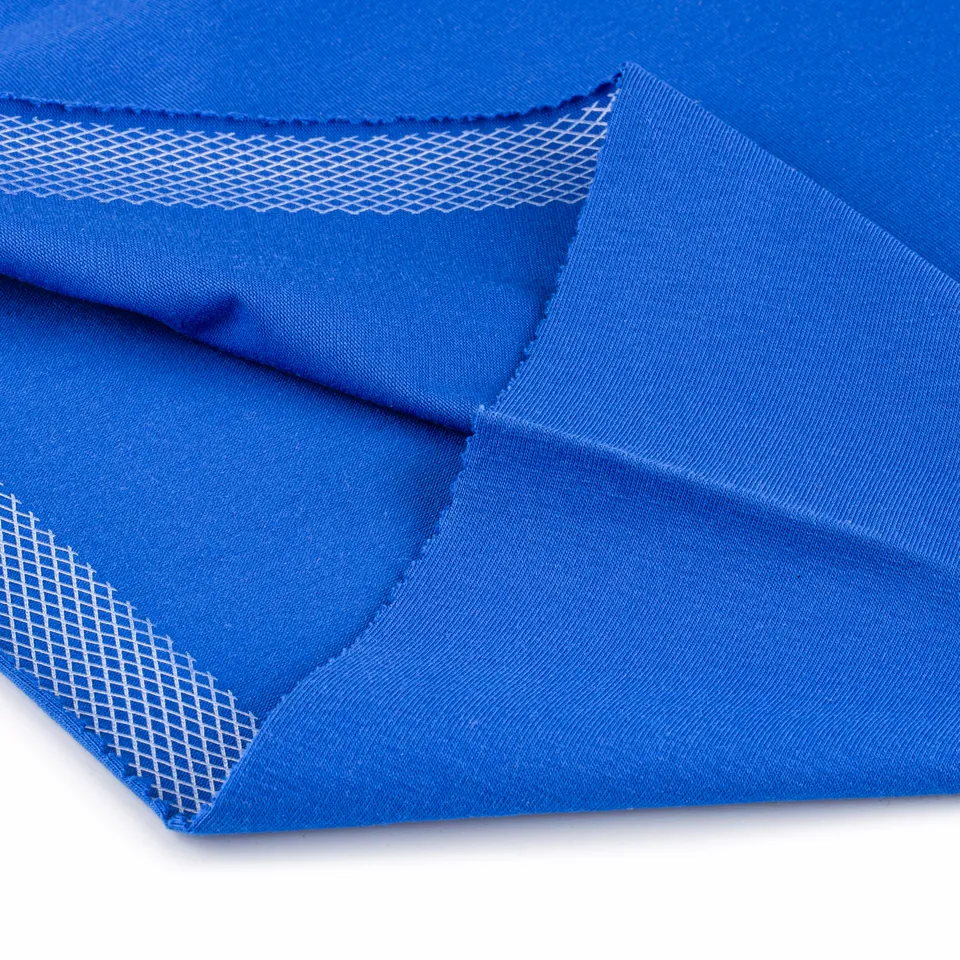
The local records specify SJ-102 as 95% cotton 5% elastane at 170, 180, 190, 200, 210 g/m² with Enzyme + compacted finishing, and SJ-103 as 95% viscose 5% elastane at 160, 170, 180, 190, 200 g/m² with Bio-polish + silicone finishing. Neither record provides a skater-dress waist-recovery, seam, drape or care result. Keep the precise sample option and any secondary component named. The common elastane percentage and overlapping weights do not establish equivalent behaviour in the joined fitted-bodice and flared-skirt design.
Review bodice and skirt balance after agreed care
Agree the care and measurement procedure with the responsible quality team before exposure. Record relevant bodice lengths and widths, waist-seam position, skirt measurements and hem balance using a documented garment state. CottonWorks links dimensional stability to fit and appearance; apply that concern to both sections rather than reporting only an overall dress length. Reassess the waist junction and intended movement after the procedure. Ask the specialist to interpret any changed relationship and establish programme-specific criteria. A compacted or bio-polish finish label cannot supply a ready-made pass limit for this assembled garment.
CottonWorks: Quality Testing — dimensional stability — Dimensional stability affects garment fit and appearance. The proposed joined-section review is editorial application, without invented care, recovery or drape pass limits.
Release the combination and the corrections actually checked
Close every issue with its observation, proposed revision and the repeat check undertaken. A hypothetical skirt might look attractive before care while its waist junction later develops unacceptable distortion; the initial flare photograph would not resolve that finding. Keep earlier and revised samples together, and state the sizes, colourways and construction assessed. A later change to lining, waist support, gathering or bodice material needs a review decision. The accepted record should demonstrate this skater dress's reproducible configuration while leaving untested recovery, coverage and drape properties outside the release.
Technical background and scope
This is a structured editorial draft. Garment-specific development advice is paired with existing catalogue records; compatibility must be established by sampling. AL KUMAŞ supplies fabric. Cutting, sewing and finished-garment production are separate unless explicitly agreed.