



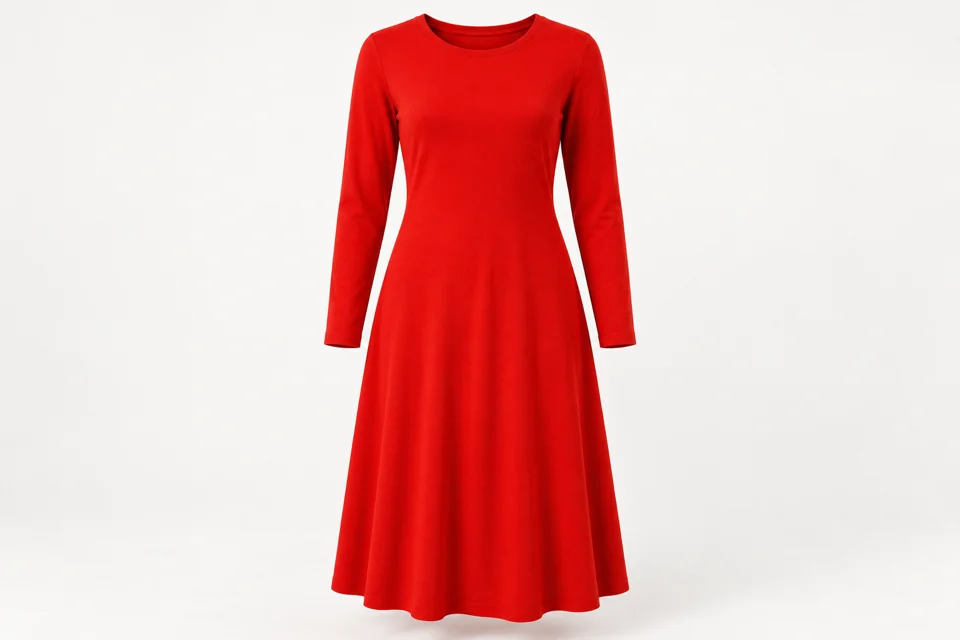


Put paired sleeves into the dress marker from the start
The material estimate needs the complete dress front and back, both actual long-sleeve patterns, neckline pieces and any specified wrist components or lining. Do not cost a sleeveless dress and add an arbitrary sleeve percentage. Sleeve width, shape and surface direction can affect nesting beside the body panels. Provide the intended dress length, sleeve length and ordered size ratio before the cutter calculates demand. The goal is a transparent marker for the accepted long-sleeve configuration, not a favourable body-only total that excludes the parts most likely to change during movement fitting.
Keep sleeve corrections distinct from body-area changes
If the fitting team increases elbow or forearm ease, ask the pattern technician to identify which sleeve outlines changed and whether the armhole or body also needs revision. A local correction may alter the layout even when the overall dress length stays fixed. Give the cutter the revised pattern rather than retaining the first consumption because the style name is unchanged. Do not reduce sleeve ease to preserve an early cost target without another accepted fit decision. Material usage follows the developed garment; it should not quietly determine the wearer's permitted movement.
Use an area example to expose a sleeve-cost assumption
For invented arithmetic only, suppose a sleeve revision adds 0.02 square metres to each sleeve's net pattern area. The pair adds 0.04 square metres, which at 190 g/m² represents 7.6 grams before cutting losses and allowances. These are not real sleeve dimensions, a prescribed ease correction or an AL KUMAŞ yield. The calculation shows one area-mass effect but cannot establish how the new shapes fit around the dress panels. Ask for the actual revised marker and accepted sample before treating that small theoretical mass change as the complete commercial consequence.
Ask how long sleeves share the available width
Have the cutter show the permitted sleeve and body orientations at the confirmed usable width, including how left and right pieces are identified. CottonWorks describes marker planning as arranging garment pieces for utilisation. Applied here, the question is whether the actual sleeves nest with the long body without unapproved rotation, joins or artwork changes. A directional print can restrict an otherwise economical arrangement. Request the layout behind the estimate and identify the size ratio it covers. A theoretical conversion from kilograms to metres cannot answer those pattern-placement questions on its own.
CottonWorks: Garment Construction — marker making — Markers arrange actual garment pieces for utilisation. The sleeve-area example uses invented figures, not a prescribed fit correction or confirmed dress consumption.
Catalogue starting points
The listed SJ-103 body is 95% viscose 5% elastane with 160, 170, 180, 190, 200 g/m² options and Bio-polish + silicone finishing. The paired-sleeve cotton comparison, SJ-102, is listed as 95% cotton 5% elastane at 170, 180, 190, 200, 210 g/m² with Enzyme + compacted finishing. These entries confirm neither usable width nor a long-sleeve dress consumption figure. Ask for the specific current offer and its supply format before comparing purchase units. A shared nominal GSM does not establish that each route uses the same accepted body, sleeve or dimensional allowance.
Cost the actual wrist and armhole assembly
A folded sleeve hem, a separately supplied cuff and another specified finish involve different materials and work. State which one appears in the chosen design and ask the garment maker to identify its inclusion. Add the armhole assembly, neckline components and any actual lining to the costing brief without double counting parts already in the marker. Separate pattern compensation, cutting losses and purchasing buffers, showing which assumptions are confirmed. A small-looking cuff or support item should not disappear into an unexplained fabric allowance if another supplier or operation is responsible for it.
Compare completed body-sleeve options with their revisions attached
Present each material route with the accepted body and sleeve pattern, dress length, wrist treatment, size ratio and relevant artwork constraints. If only one route has passed the movement review, identify the other as provisional instead of treating price as evidence of equivalence. Request consistent commercial units and terms for the actual quantity programme. Recalculate when a sleeve, armhole or body-length decision changes. This creates a useful comparison of developed long-sleeve dresses rather than a contest between kilogram prices whose underlying garment shapes, components and outstanding qualification work are different.
Technical background and scope
This is a structured editorial draft. Garment-specific development advice is paired with existing catalogue records; compatibility must be established by sampling. AL KUMAŞ supplies fabric. Cutting, sewing and finished-garment production are separate unless explicitly agreed.