



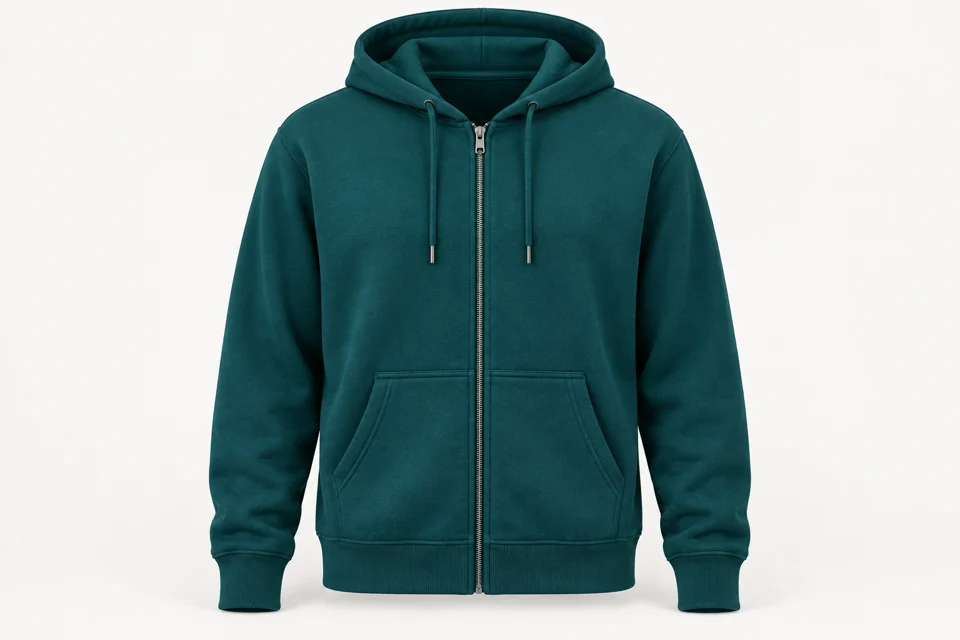
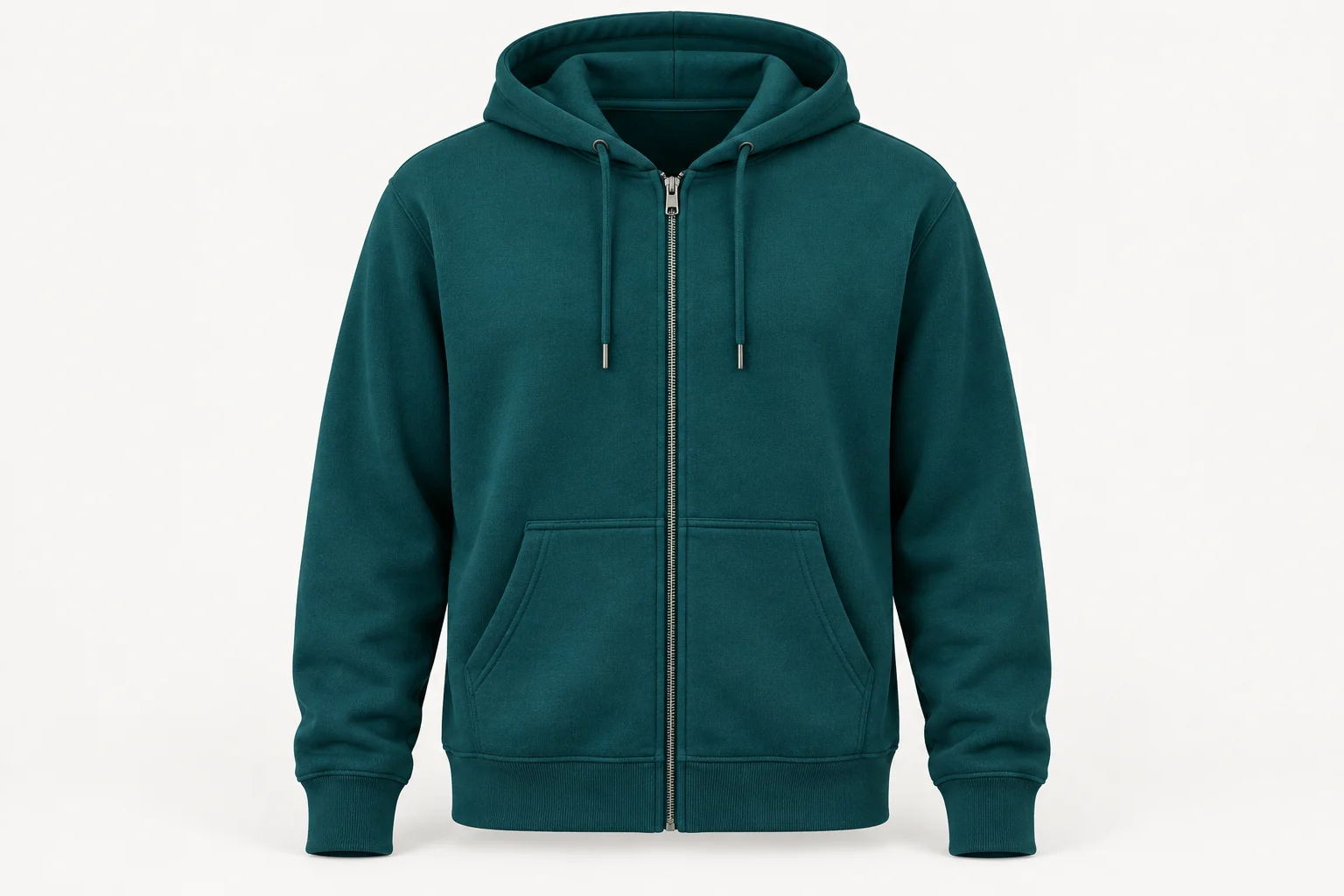


Cost the split front as a different pattern
Converting a pullover to a zip-front hoodie is not simply a matter of adding the fastener price. The front pattern becomes separate pieces, the opening needs its own allowances and finishing, and the pocket arrangement may change. Ask for the zip-front pattern version before requesting a consumption estimate. List the front facings or support strips explicitly. Otherwise the buyer may compare a complete pullover cost against an incomplete zip-front estimate and discover the missing operations only when the garment maker prepares the production quotation. Show the changed components in the costing revision rather than concealing them inside a general surcharge.
Select a weight within a clearly named route
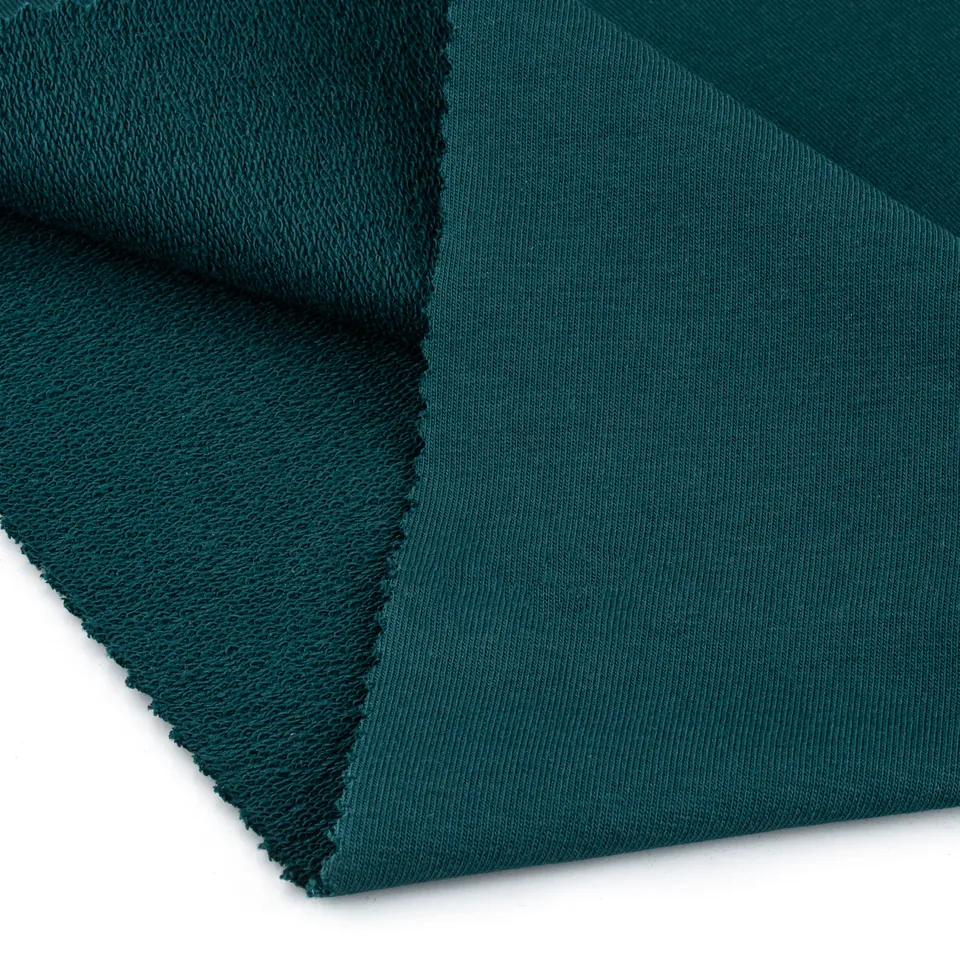
FT-601 offers 240, 260, 280, 300 and 320 g/m² in a 70% cotton and 30% polyester two-thread construction labelled unbrushed silicone. FT-603 lists 320, 345, 370, 395 and 420 g/m² with 65% cotton and 35% polyester in a three-thread brushed construction labelled brushed anti-pilling. A 320 g/m² option exists in both records, but the articles are not equivalent materials. Quote the chosen article, weight and finish together and ask the supplier to confirm the current finished specification and tolerance.
Obtain width before planning paired fronts
The local records do not verify usable width or supply format for these offers. Give the confirmed width to the cutting team and ask it to lay out the left and right fronts, sleeves, back, hood and pocket components in the intended size ratio. Directional restrictions should be documented rather than assumed absent. Separate front pieces may fit differently into the marker from a one-piece front, but they do not guarantee either a saving or an increase. Let the actual pattern layout establish that result.
Calculate a hypothetical body-material allowance
For a teaching example, suppose an open-width offer is 320 g/m² at 1.75 metres usable width. Each theoretical linear metre weighs 560 grams. If a representative marker allocates 1.45 metres per hoodie, that is 812 grams of body material. At an invented price of 7 currency units per kilogram, the corresponding body-fabric value is 5.684 units before rounding and any separately agreed allowances. Width, marker consumption and price here are hypothetical inputs, not AL KUMAŞ terms or a prediction for either catalogue article.
Give fasteners and opening support their own cost lines
Add one correctly specified separating fastener per garment only if that is the chosen construction, then list any facing material, support, lining and rib that the body marker excludes. Fastener length and type must match the approved pattern; changing them can require another opening trial. The manufacturing quote should also show the relevant assembly operations, not treat them as fabric cost. If self-fabric facings are already included in the 1.45-metre marker example, do not charge their fabric a second time on another line.
Keep care-related corrections distinct from marker loss
CottonWorks explains that material construction and processing contribute to dimensional change. It does not provide a shrinkage allowance for this zip-front combination. Ask the garment team to base pattern compensation on the agreed evidence, while the marker report explains its own utilisation and waste assumptions. A full opening also joins body fabric to fastener tape and other components; it needs a compatible assembly assessment rather than a universal percentage applied to everything. Identify which allowances are already built into the pattern before purchasing adds contingency.
CottonWorks: Shrinkage & Skewing — Construction and processing influence dimensional change. It does not provide a shrinkage allowance or validate the explicitly hypothetical width, marker consumption and price example.
Compare the complete cost at the same design stage
Use a comparison sheet separating body material, other textiles, fastener, sewing and decoration. Record the same size distribution, approved opening construction and delivery basis for each route. A change from self-facing to another finish may alter both material consumption and sewing work, so evaluate both effects together. Recalculate when the zip length, body length or size mix changes. Before committing the order, reconcile the marker with the supplier's confirmed usable width and the garment maker's component list; a kilogram price alone cannot settle the finished hoodie's economics.
Technical background and scope
This is a structured editorial draft. Garment-specific development advice is paired with existing catalogue records; compatibility must be established by sampling. AL KUMAŞ supplies fabric. Cutting, sewing and finished-garment production are separate unless explicitly agreed.