



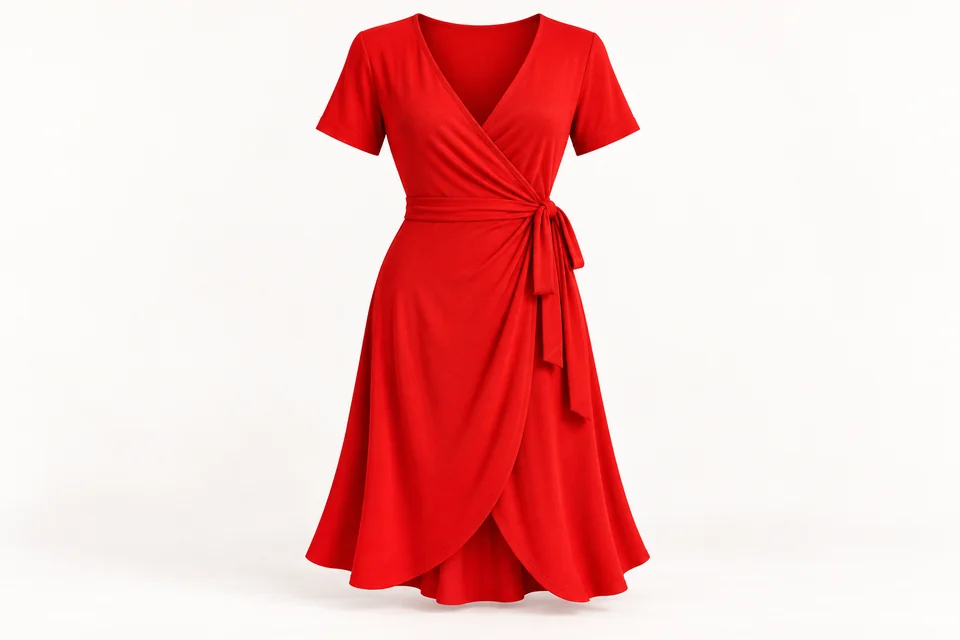
Begin with the silhouette in movement
A dress asks more of a fabric review than a small swatch can reveal. The length of the panels, the intended ease and the way the wearer moves all become part of the design. Start by describing the silhouette: a loose T-shirt dress, a fitted body, a wrap construction or a longer flowing shape. Identify which areas should follow the body and which should fall freely. That description is more useful than requesting a fabric that is simply soft and stretchy.
The dress profiles in the garment library are general application and inspiration guides. They are retained for development reading; they are not confirmed products in the sixty-five-row product planning list. AL KUMAŞ supplies knitted dyed fabrics, and the finished dress needs its own pattern, sewing and product approval.
Compare the actual fibre and construction records
The catalogue offers SJ-103, recorded as 95% viscose and 5% elastane single jersey with options from 160 to 200 g/m², and SJ-104, recorded as 95% modal and 5% elastane at 150–190 g/m². Those descriptions give buyers two material routes to discuss. They do not prove a particular drape, recovery or coverage result. Request representative finished samples and assess them against the intended garment rather than assigning a behaviour from the fibre name alone.
A cotton or interlock route may also be worth considering for a different design intention. Explain the trade-off you are willing to explore: a change in surface, a more deliberate body shape or a different feel. Do not let a nominally similar weight hide a changed composition or construction. Record the offered article and finish for every sample so feedback remains connected to a specific proposal.
Review long panels and critical openings
Ask the sample room to use the intended panel length and a representative size. Inspect the garment standing and moving, and choose positions that are relevant to the design. A wrap dress needs a deliberate review of its overlap and closure approach. A longer skirt needs attention to how the hem hangs. A fitted body needs the pattern team's defined ease and movement plan. These observations guide development; they are not a substitute for an agreed performance test.
Review necklines, armholes, waist joins and any ties or fasteners as part of the complete assembly. If the design includes a lining or support layer, identify that material and test the intended combination. A body fabric should not be approved on the assumption that an unspecified lining will resolve a concern later. Give each open question an owner before the next sample is cut.
Make coverage a garment-level observation
Coverage depends on the chosen fabric, colour, pattern and conditions of use. Examine the representative garment in the intended positions and agree the evaluation approach with the technical team. Do not label a fabric opaque from a folded cutting or a single website photograph. If the project needs a quantified requirement, have the responsible specialist define the method and acceptance criteria rather than inventing a universal pass value.
If the dress will be printed, review the artwork on the proposed material and at the intended scale. Check how the pattern pieces place the motif and how seams interrupt it. A small decorated cutting can establish one part of the visual discussion, but a representative assembled sample is needed to see placement across the garment. Retain both artwork and material revisions with the accepted sample.
Confirm the handover before buying bulk cloth
Agree the care-related evaluation and share the results with the pattern team. CottonWorks' dimensional-stability guidance provides background on why processing history matters; it cannot establish a result for the selected dress. Record which fabric, finish and sample were assessed. If the pattern or supply proposal changes, decide what must be reviewed again.
End with a clear purchasing file: article proposal, finished weight, usable width, colour reference, required quantity and sample status. Keep the approved dress reference linked to its pattern and component records. The strongest fabric choice is the one that supports the actual silhouette through the agreed development process, not the one whose swatch appears most luxurious before the garment exists.
Source and specification notes
Catalogue figures come from the recorded fabric specifications. Product-planning comparisons retain the source specifications; numeric garment SKUs are not fabric article IDs. General technical references are linked beside the relevant discussion. Development workflow recommendations are editorial guidance.
Compare source product plans ↗