



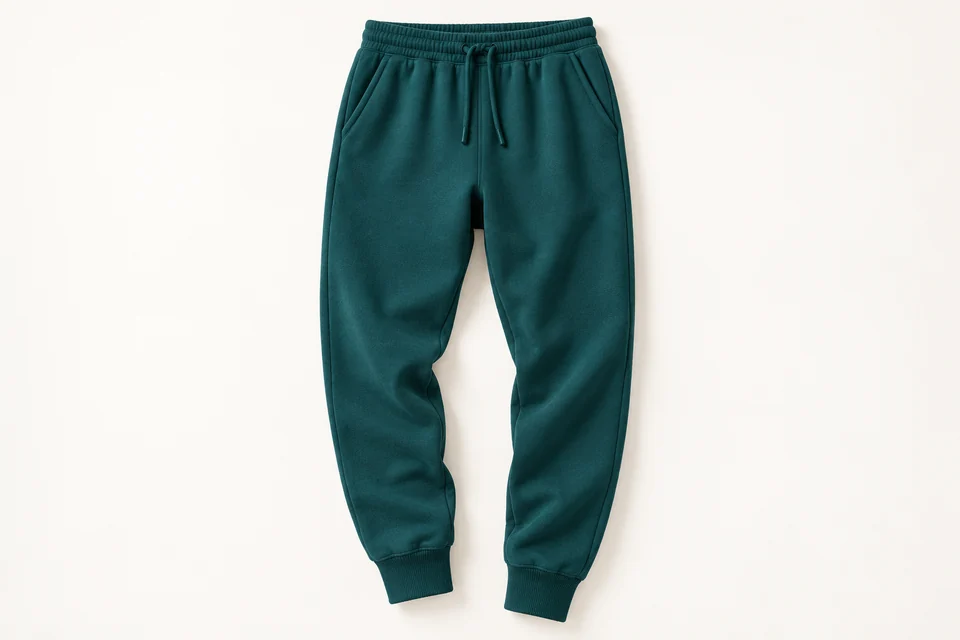


Start at the ankle, then work up the leg
A tapered jogger asks the body fabric to work with a narrower lower leg and a finished ankle opening. Decide whether the intended shape is close through the calf, relaxed with a short taper, or deliberately oversized above a firm cuff. Show those proportions in a side view as well as a front drawing. The cuff cannot correct an unsuitable leg pattern: gathering a very wide leg into a narrow band creates a different volume from shaping the leg itself. Develop that transition before naming a preferred fabric weight.
Use the overlapping catalogue weight as a comparison point
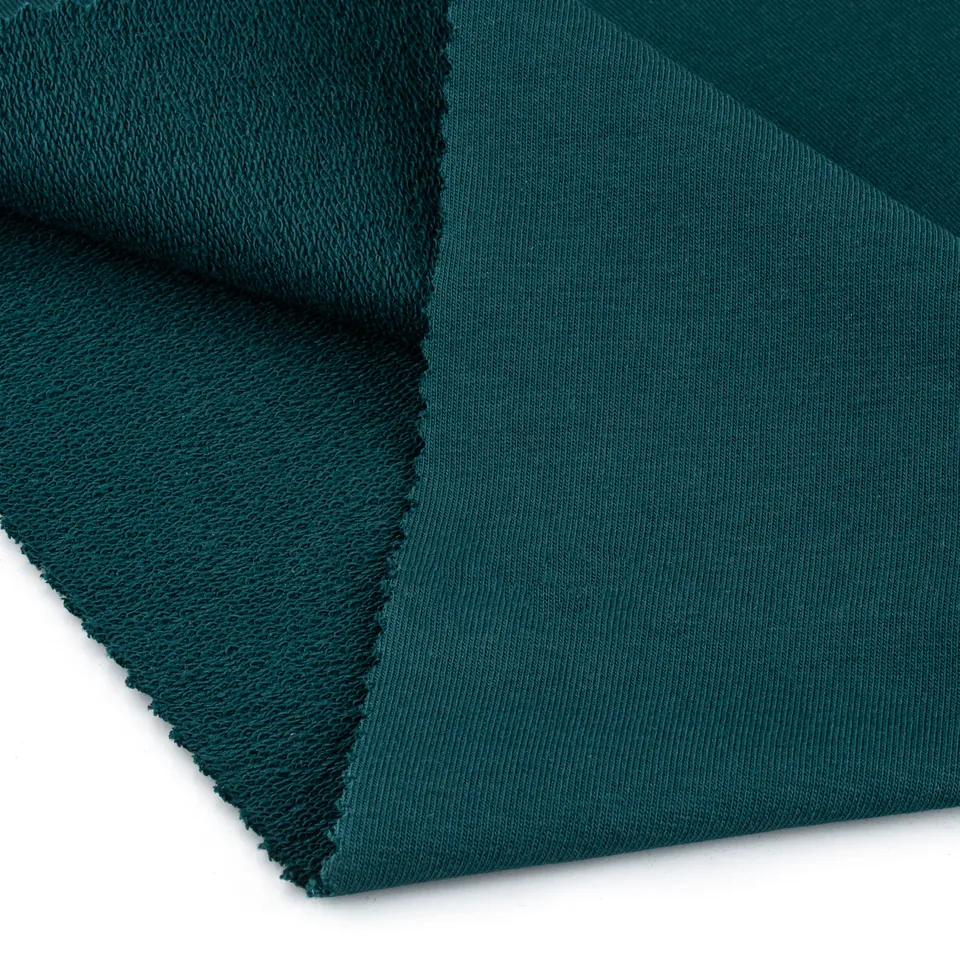
FT-601 is recorded as 70% cotton and 30% polyester at 240, 260, 280, 300 and 320 g/m². FT-602 has the same recorded composition and options of 300, 325, 350, 375 and 400 g/m². The finish labels distinguish FT-601 as unbrushed with silicone and FT-602 as unbrushed and compacted. Both have a 300 g/m² entry; measured warmth and recovery remain unprovided. Confirm the offered version against those catalogue labels and request identified cuttings. Compare the intended body and leg shape without assuming that either code means a brushed interior, proven recovery or tested insulation.
Treat the cuff as a second material decision
The ankle opening must accommodate the foot when dressing and then sit at the intended position. Ask the pattern and sewing team to evaluate the finished cuff, its seam and the leg attachment together. If a separate rib is proposed, obtain its own specification and sample; neither FT body record approves that component. Consider where the cuff join sits and whether its bulk is acceptable inside the ankle. A cuff that looks neat on a hanger can still be difficult to put on or leave the lower leg sitting differently from the drawing.
Make the pocket carry its intended load
Decide whether a phone, keys or another item is part of the use brief, then make the pocket opening and bag accordingly. A deep bag may need anchoring or a different shape to avoid swinging against the thigh. Ask for a worn comparison with the intended item and without it; record how the opening, waist and side seam change. Do not claim that a heavier body automatically solves pocket sag. Pocket material, placement, reinforcement and the body pattern can all be part of the development decision.
Balance seat room with a defined knee shape
A casual jogger may need room for sitting and stepping without being developed as a compression or technical training garment. Ask the fit technician to review seat depth, thigh ease and the bend through the knee in the actual fabric. Compare the sample immediately after fitting and after an agreed recovery interval. That is a development observation, not a laboratory result or a promised resistance to bagging. If visible knee growth is unacceptable, request an appropriate assessment and consider both pattern and fabric alternatives rather than hiding the issue with darker colour.
Examine how the waistband and drawcord are built
A drawcord inside a channel introduces components beyond the body fabric: cord, eyelets or stitched openings, channel seams and any local support. Identify who specifies each one and test the assembled waist. Evaluate whether the cord moves freely, whether the channel twists and whether the knot or ends sit as intended for the adult design. Keep optional drawcord styling separate from the function of the waist elastic. Changes to channel depth or waistband layers can alter bulk even when the same FT body article is retained.
Approve the garment rather than the swatch alone
CottonWorks distinguishes fabric quality characteristics from finished-garment fit and seam integrity. Use that distinction when closing the selection: approve the tapered leg, cuff access, loaded pocket and waistband as one documented sample. Record the body article, offered weight, component references and pattern version. Mark any performance request still awaiting evidence. This is an adult jogger development brief; it does not establish children’s drawcord compliance or technical sportswear capability. The selected sample supports the particular design trial, not a guarantee that the catalogue article suits every jogger silhouette.
CottonWorks: Garment Quality Control — Fabric quality and finished-garment fit/seam integrity are distinct considerations. Jogger-specific workflow is original advisory content.
Technical background and scope
This is a structured editorial draft. Garment-specific development advice is paired with existing catalogue records; compatibility must be established by sampling. AL KUMAŞ supplies fabric. Cutting, sewing and finished-garment production are separate unless explicitly agreed.