



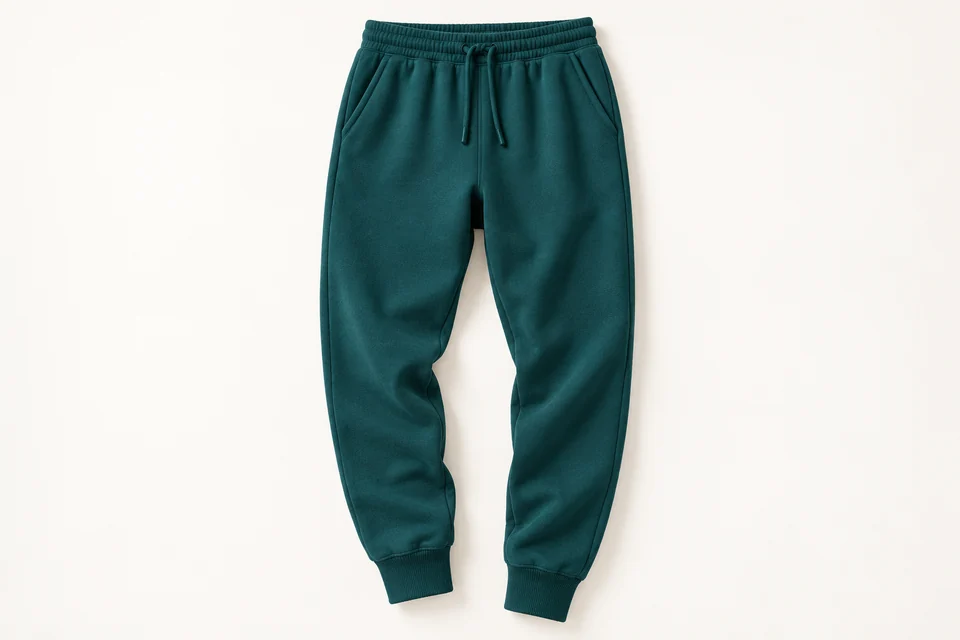


Count the components hidden by a simple jogger silhouette
A jogger costing can omit surprisingly much material when it starts with two leg panels and a generic allowance. List the actual front and back pieces, pocket facings and bags, waistband, gusset if used, and cuffs. Mark which pieces use the body article and which use a separate material. A doubled waistband is not the same cutting requirement as a single-layer extension with a casing. Keep this component map beside the style drawing so a later design change cannot quietly leave the consumption sheet describing an earlier version.
Compare a chosen finished weight, not two broad ranges
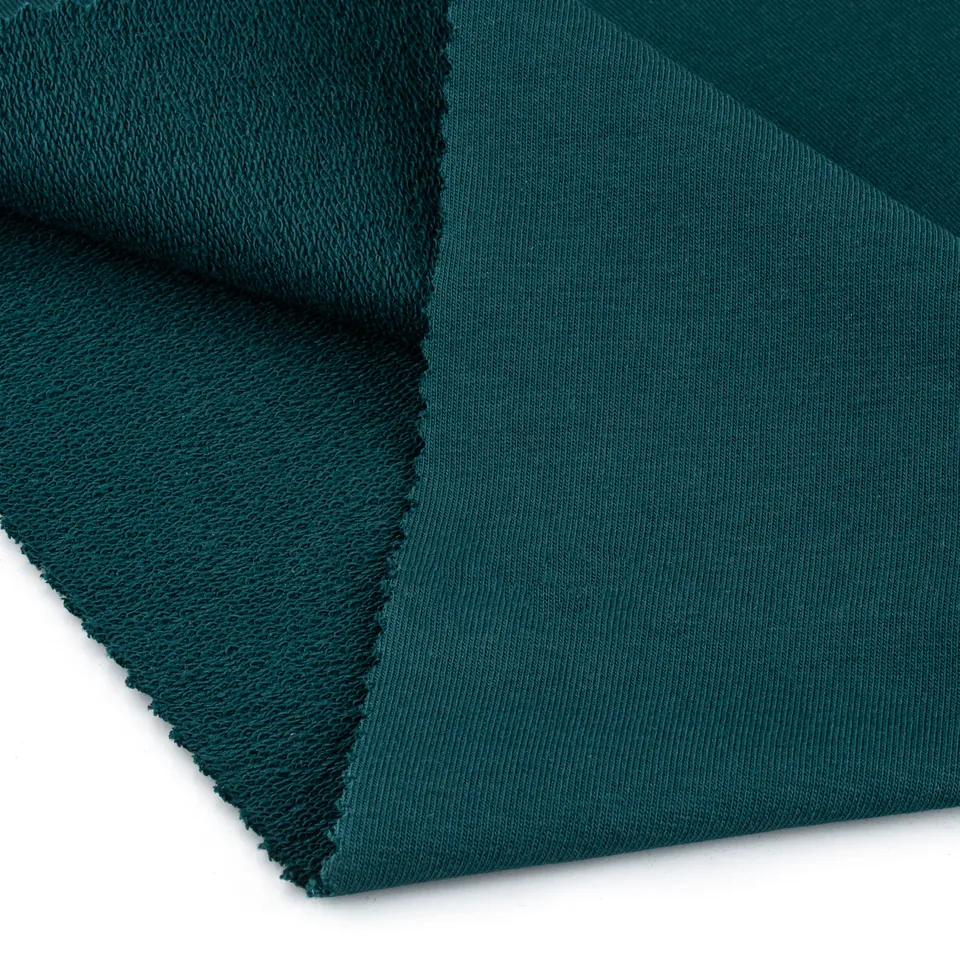
The FT-601 catalogue provides 240, 260, 280, 300 and 320 g/m²; FT-602 provides 300, 325, 350, 375 and 400 g/m². Both compositions are 70% cotton and 30% polyester; the recorded finishes are unbrushed with silicone for FT-601 and unbrushed, compacted for FT-602. For a first commercial comparison, ask which exact weight and finish each offer covers, together with its tolerance and measurement basis. Do not cost FT-601 at its lightest entry and FT-602 at its heaviest, then attribute the entire difference to the code. No verified usable width accompanies these local records.
Use a marker-level mass example
For illustration only, suppose a cutting team reports a combined net area of the body pattern pieces of 1.80 square metres per jogger. At 300 g/m², that area corresponds to 540 grams; at 350 g/m² it corresponds to 630 grams. The 90-gram difference illustrates how mass changes when the same area is assumed. It is not an AL KUMAŞ consumption estimate, and the marker itself may change with the actual fabric and pattern. The calculation excludes separate cuffs, elastic, waste, dimensional allowances and purchasing contingency. Keep those quantities visible rather than absorbing everything into one unexplained kilogram figure.
Check whether the taper creates usable nesting space
Long tapered pieces may leave spaces that appear useful on a paper layout, but a pocket facing or cuff can fill them only if its grain and direction rules permit it. Ask the marker maker to identify those constraints and use the proposed size ratio. A side panel can split the leg into narrower components yet add seam allowances; neither a saving nor a penalty should be assumed without a new marker. Compare the accepted plain-leg and panelled versions at the confirmed usable width before choosing the apparently economical design.
Keep cuff and waistband supply units separate
If ribbing is supplied in a different width, format or commercial unit from the body fabric, give it a separate calculation. The cuff needs enough finished opening for the intended adult wearer, so it cannot simply be made shorter to improve an estimate. Request its pattern dimensions and component count from the garment maker. Separate waistband elastic and drawcord lengths from fabric consumption as well. A mixed-material bill of materials can then be recalculated when one component changes without rebuilding an unreliable body-only rule of thumb.
Allocate dimensional and process allowances once
CottonWorks identifies fabric construction, processing and garment care as contributors to dimensional change. Obtain relevant evidence for the offered FT article, then have the technical team explain how it affects the leg and waistband patterns. Keep that pattern decision distinct from marker loss, cutting loss and an agreed order contingency. The cuff attachment may involve a different material response from the body, so an overall allowance cannot explain every component. Assign each assumption an owner and prevent the same risk from being added repeatedly by purchasing, cutting and garment production.
CottonWorks: Shrinkage & Skewing — Construction, processing and garment care affect dimensional change; does not supply article-specific shrinkage or pass limits.
Compare the complete cost with a change log
Build the final costing with body article, nominal weight, confirmed usable width, marker revision, size mix and separate component requirements. Ask for a consistent price and delivery basis across offers. If the pocket changes from patch to zipped entry, or the ankle changes from hemmed to ribbed, record that revision and obtain the relevant material recalculation. The useful figure is the cost of the approved jogger design under explicit assumptions. A lower price per kilogram cannot settle the comparison when one route requires a different mass or additional materials.
Technical background and scope
This is a structured editorial draft. Garment-specific development advice is paired with existing catalogue records; compatibility must be established by sampling. AL KUMAŞ supplies fabric. Cutting, sewing and finished-garment production are separate unless explicitly agreed.