





Select the opening's corners and spans as one design
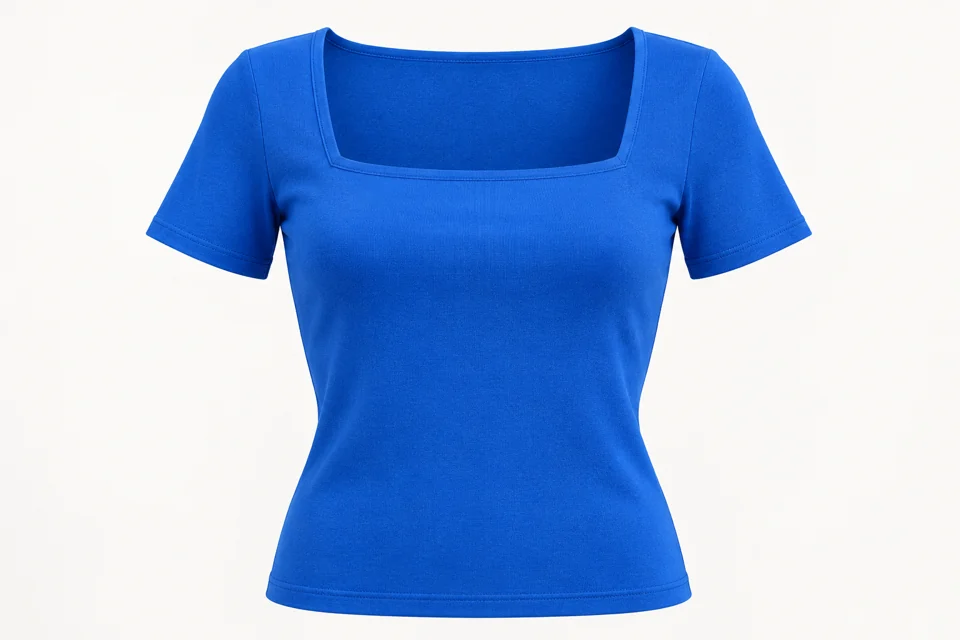
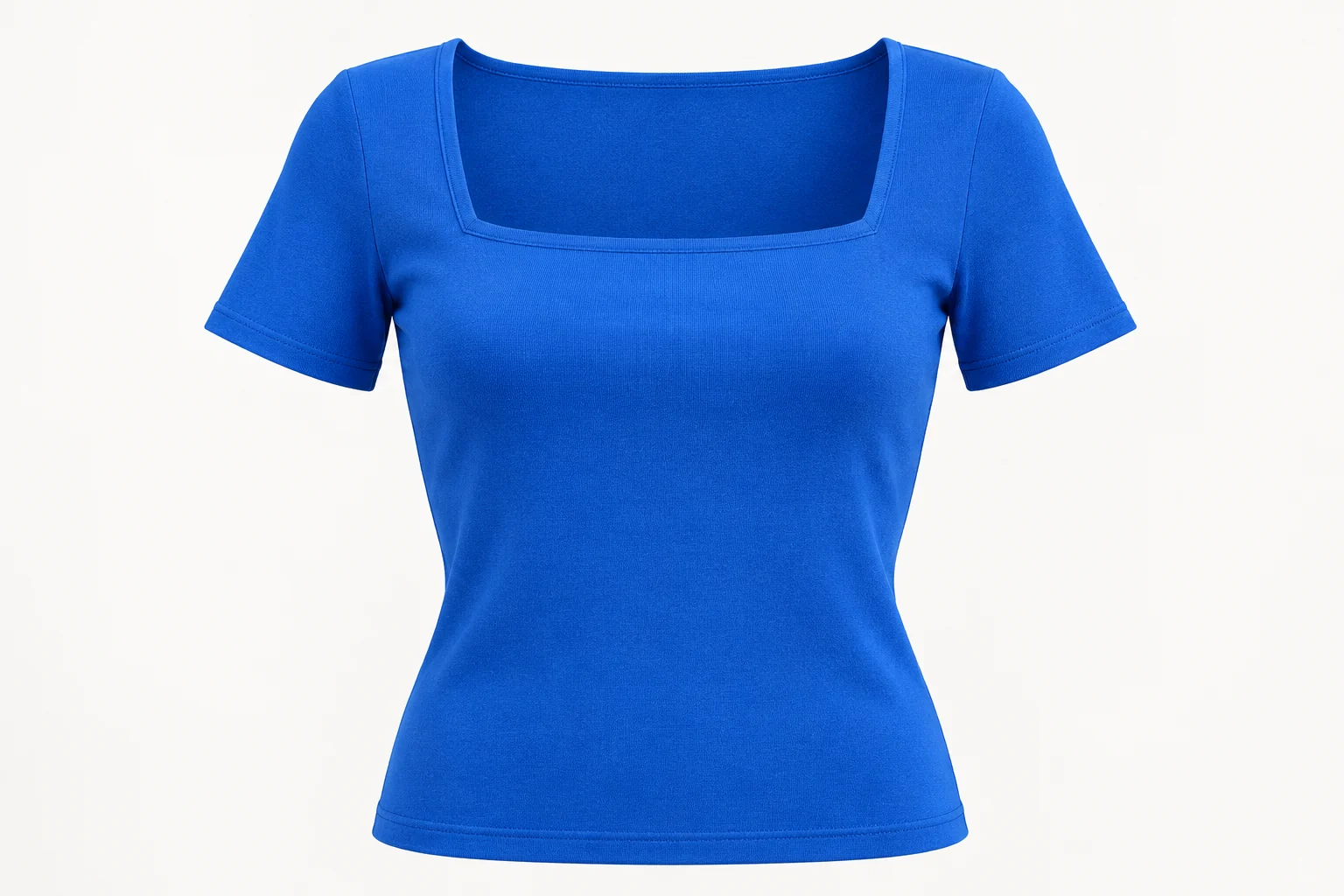
A square-neck top needs a defined relationship between its lower neckline span, side rises and corner treatment. Draw the intended shape, including whether the corners look sharp or deliberately softened, before choosing a material. The style name alone does not establish exact angles or coverage. Ask the maker to include the actual proposed edge finish in the first complete sample. A smooth cutting or a pleasant stretch sensation cannot show how the body, support and turning sequence will create the visible corners in the finished top.
Read the same fibre percentages without assuming equivalent behaviour
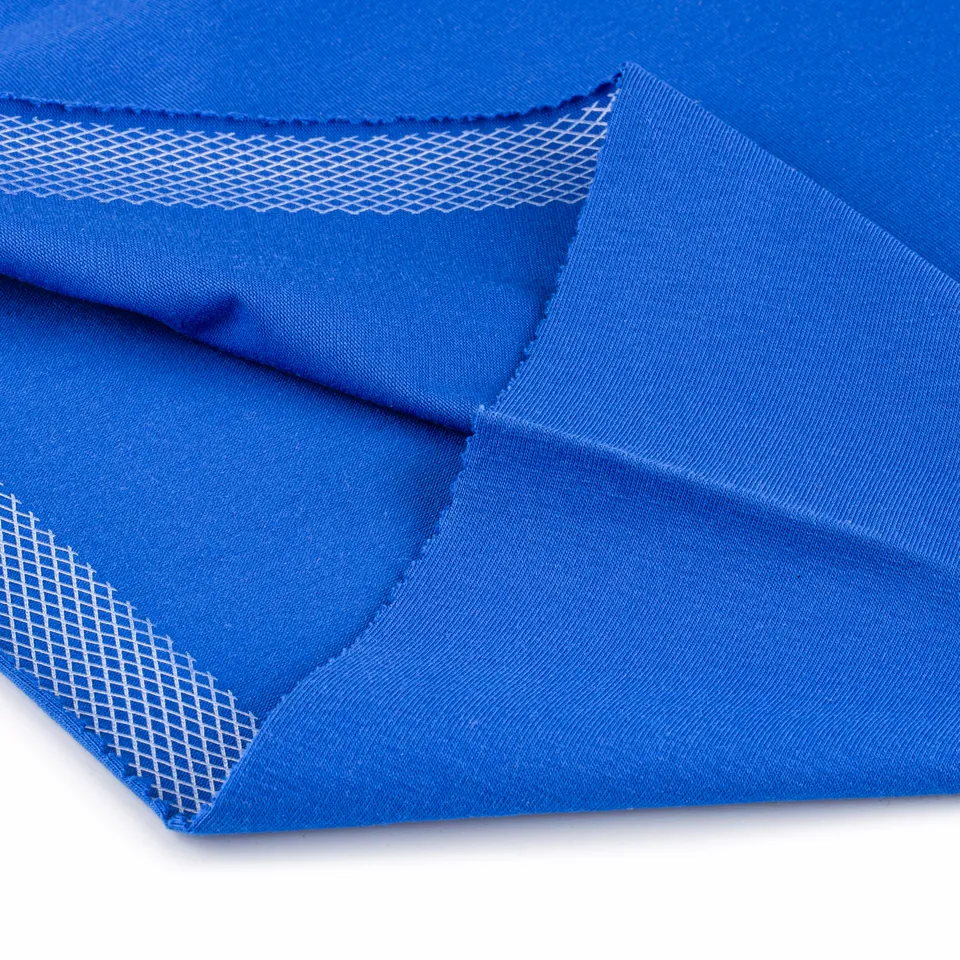
SJ-102 and FR-401 both record ninety-five percent cotton and five percent elastane, but one is single jersey and the other fine rib, with different weights and finishes. Their listed masses do not overlap. Compare actual offered versions with the pattern and assembly changes documented, rather than presenting the choice as an isolated fibre experiment. CottonWorks includes final fabric properties in garment fitting, supporting a sewn comparison. Neither the common elastane percentage nor the fine-rib label proves corner recovery, opacity or how much pattern reduction the proposed square-neck shape can accept.
CottonWorks: Designing Knit Textiles — Final material properties are evaluated during garment fitting. The same cotton-elastane percentages do not constitute article-specific corner or recovery evidence; the sample comparison remains an editorial development proposal.
Ask for a developed corner rather than reinforcement by default
Have the maker identify the proposed facing, band or other edge treatment and explain what support, if any, it uses at the corners. Request an actual trial on the offered body material. More support is not automatically a better solution if the intended top needs another handle or appearance. Review the corner from the face and underside, including local layer build-up. If the maker proposes another sequence or component, keep that alternative identified rather than silently accepting it as the same square-neck construction with an improved fabric.
Use a construction sequence to understand the visible turn
Closet Core's own Pauline square-neck tutorial demonstrates the importance of markings and an explicit sewing-and-turning sequence for that particular pattern. It is not a specification to copy onto either catalogue knit. Use that distinction to ask your maker how its actual corner is established, where its layers turn and what the finished result should show. Do not prescribe a clipping depth or stitch setting from another garment. A buyer can request transparency about the developed operation without pretending that one tutorial supplies a universal method for every stretch-containing square neckline.
Closet Core Patterns: How to Sew the Square Neckline of Pauline — The pattern maker's own dress tutorial shows marking, stitching, turning and finishing a particular square-neck construction. The article expressly does not transfer its dimensions, clipping or machine instructions to SJ-102 or FR-401.
Check width and depth tension around both corners
Observe the completed top worn neutrally, then in a relevant reach and return to rest. Compare the two corners, lower span and side rises against the intended drawing. If one area pulls or rounds unexpectedly, ask the technical team to examine pattern, fit and assembly before declaring the material inadequate. The review concerns the actual opening, not a generic demand for extra stretch. Keep an intended softened corner distinct from an unwanted distorted one, and assess representative sizes chosen to reveal the relevant grading question rather than promising one result for all wearers.
Catalogue starting points
SJ-102 lists 95% cotton 5% elastane single jersey at 170, 180, 190, 200, 210 g/m² with Enzyme + compacted. FR-401 lists 95% cotton 5% elastane fine rib at 230, 250, 270, 290, 310 g/m² with Silicone + compacted. Confirm the actual offered finished versions and usable widths for sampling. These records provide no completed square-corner, neckline recovery or care-performance report. The finish labels describe the routes without qualifying a particular support, band sequence or visible geometry in the proposed top.
Choose a corner assembly that belongs to the selected body
Retain the accepted opening dimensions, corner appearance, edge material, support and operation reference with the body article and sample. Include both front and underside views so a later team can understand what produced the appearance. State which sizes and observations are accepted and where evidence remains open. A body, support or sequence substitution may require another targeted comparison even if the outside drawing is unchanged. The useful material choice is a documented square-neck combination, not an unsupported promise that a familiar fibre blend automatically forms defined corners.
Technical background and scope
This is a structured editorial draft. Garment-specific development advice is paired with existing catalogue records; compatibility must be established by sampling. AL KUMAŞ supplies fabric. Cutting, sewing and finished-garment production are separate unless explicitly agreed.