



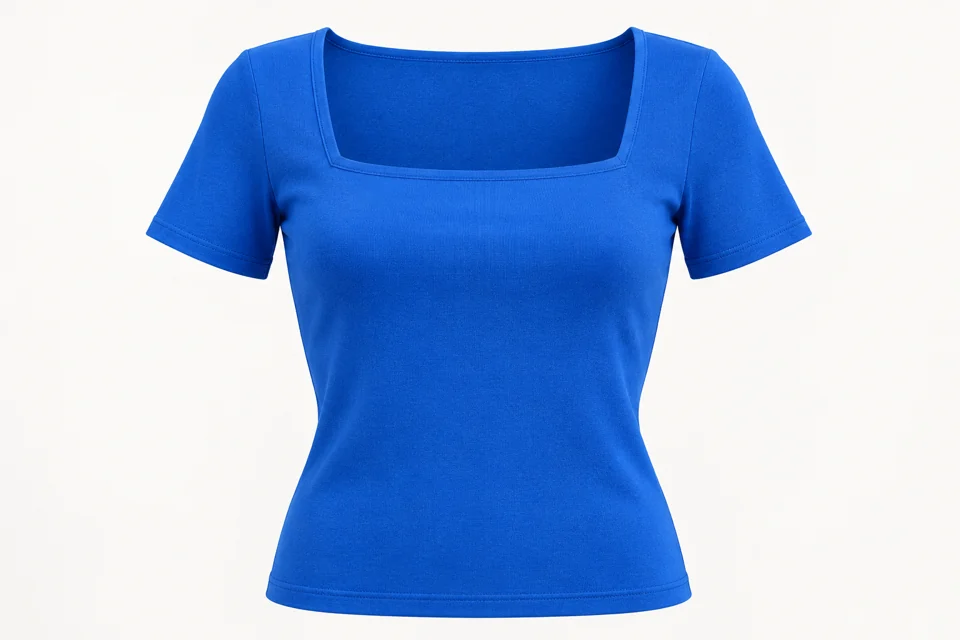
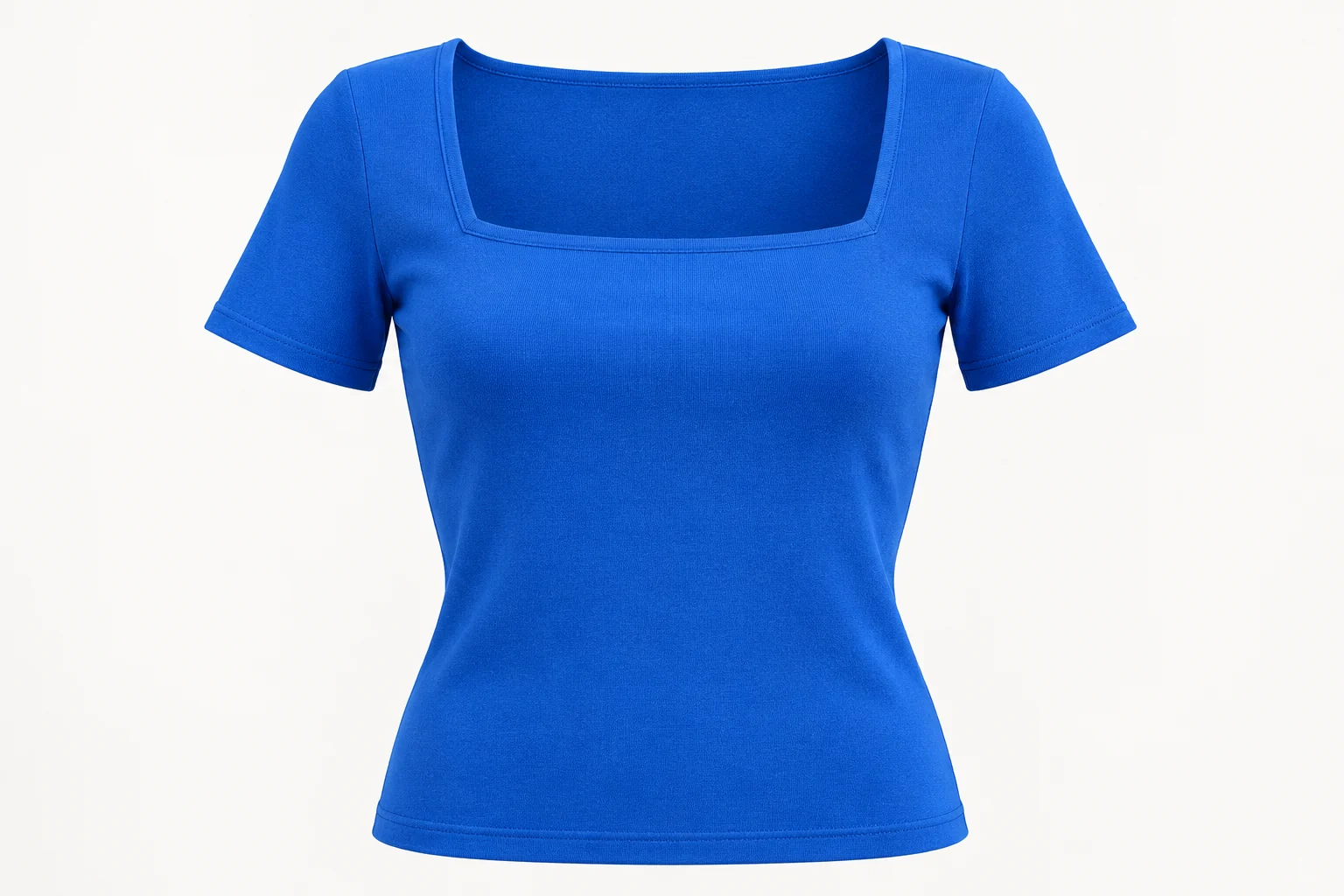


Cost the corner construction rather than a rectangular cut-out
A square-looking neckline on a drawing does not mean the material estimate is simply body area minus a rectangle. The accepted pattern includes its actual edge components, allowances and any support, while the corner operation has a defined assembly scope. Give the cutter and maker that developed proposal before requesting a complete cost. If two finish routes are being compared, identify each one separately. A body-only estimate may be useful early information, but should not be presented as the cost of an accepted square-neck top whose defining corners remain outside the calculation.
Compare the non-overlapping catalogue weight ranges openly
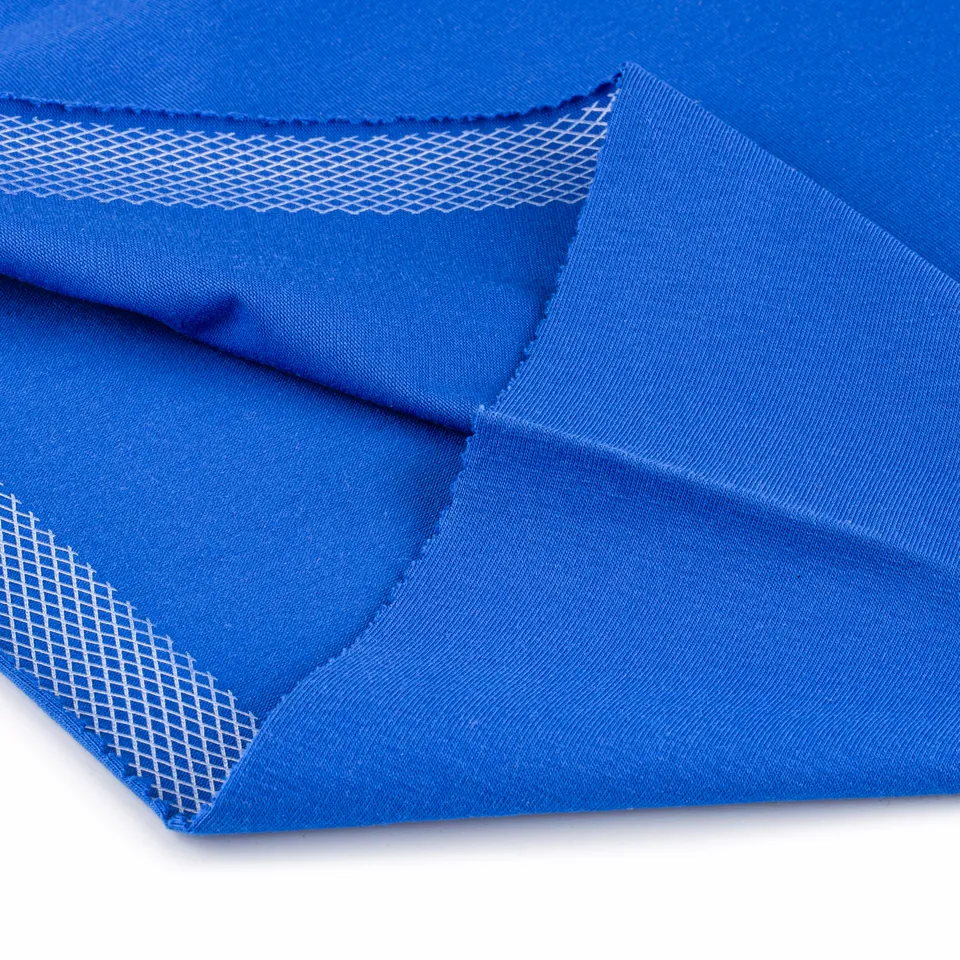
The two candidate records have the same stated cotton-elastane proportions but different constructions, finish labels and listed masses. Ask for exact offered finished weights, then cost the samples that actually meet the intended design. GSM describes mass per square metre, not corner quality or assembled bulk. A heavier article can still require another developed edge solution, so do not credit it with automatic savings in support or sewing. Keep any pattern or component adaptation attached to the comparison instead of suggesting that the price difference isolates one variable.
Use a body-area calculation only for the variable it explains
For an invented example, suppose the net body pattern area were 0.48 square metres before any separate edge components or losses. At a hypothetical 190 g/m², that area would represent 91.2 grams; at 250 g/m² it would represent 120 grams. The difference is 28.8 grams in this simplified calculation. These figures do not describe a supplied pattern or garment yield, and they do not show which material achieves the accepted square neckline. They isolate mass per area while leaving marker arrangement, support, construction and the actual fit decision for separate development.
List corner and edge pieces on their actual purchase basis
Ask the maker whether the proposed finish uses shaped facings, developed strips or another identified component, and whether those pieces use body fabric. A separate support or edge material needs its own consumption unit and offer. Give the cutter actual shapes and direction restrictions rather than assuming every small corner piece can be recovered from marker gaps. If the design chooses a different support or sequence after sampling, establish whether the component list changes. The buyer should be able to trace a cost revision to a real material or assembly decision.
Keep width and depth changes connected to the operation scope
A wider lower span or a deeper opening can change the developed pieces and the corner relationship. Issue the new pattern reference before reusing the earlier estimate. American & Efird describes communicating seams through drawings and stitch specifications, supporting a concrete assembly scope rather than a generic neckline-finishing charge. Ask the maker which operations need revision and let it develop the appropriate settings. A small change in raw material does not prove the operation is unchanged, just as an extra construction step does not justify an invented universal surcharge.
American & Efird: Stitches and Seams — Drawings and stitch specifications can communicate assembly scope. The body-area calculation is original hypothetical arithmetic, not a pattern, marker yield, universal support requirement or supplier operation cost.
Catalogue starting points
For the single-jersey route, SJ-102 records 95% cotton 5% elastane, 170, 180, 190, 200, 210 g/m² and Enzyme + compacted. For fine rib, FR-401 records 95% cotton 5% elastane, 230, 250, 270, 290, 310 g/m² and Silicone + compacted. Neither entry supplies usable width, a square-neck marker or edge-component consumption. Request the actual offered finished versions and identify which was sewn. Shared fibre proportions cannot establish equal yield, a common support requirement or the same complete cost per accepted top.
Compare the configuration that the sample actually accepted
Show body consumption, edge components, any separate support, pattern, marker and assembly reference with each proposal. Keep the actual size ratio and offered width beside the figures, identifying estimates and agreed allowances without inventing standard losses. If the corner solution changes during fitting, update the affected cost information before purchase discussions advance. This lets the buyer compare complete material-and-construction routes, understanding whether a difference comes from fabric mass, pattern arrangement or developed operations, rather than treating the square outline as proof of a simple or universally cheap finish.
Technical background and scope
This is a structured editorial draft. Garment-specific development advice is paired with existing catalogue records; compatibility must be established by sampling. AL KUMAŞ supplies fabric. Cutting, sewing and finished-garment production are separate unless explicitly agreed.