



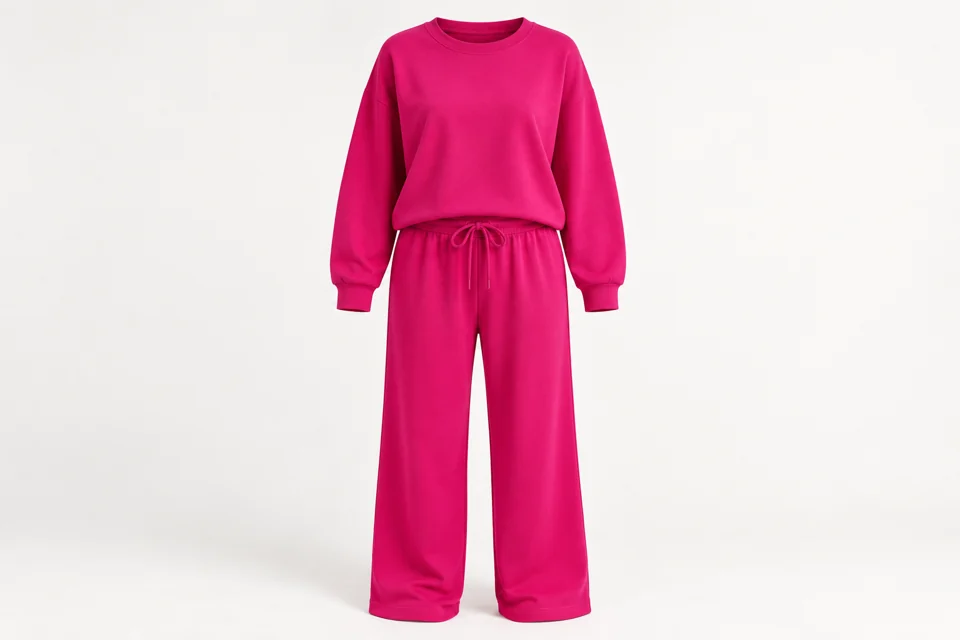
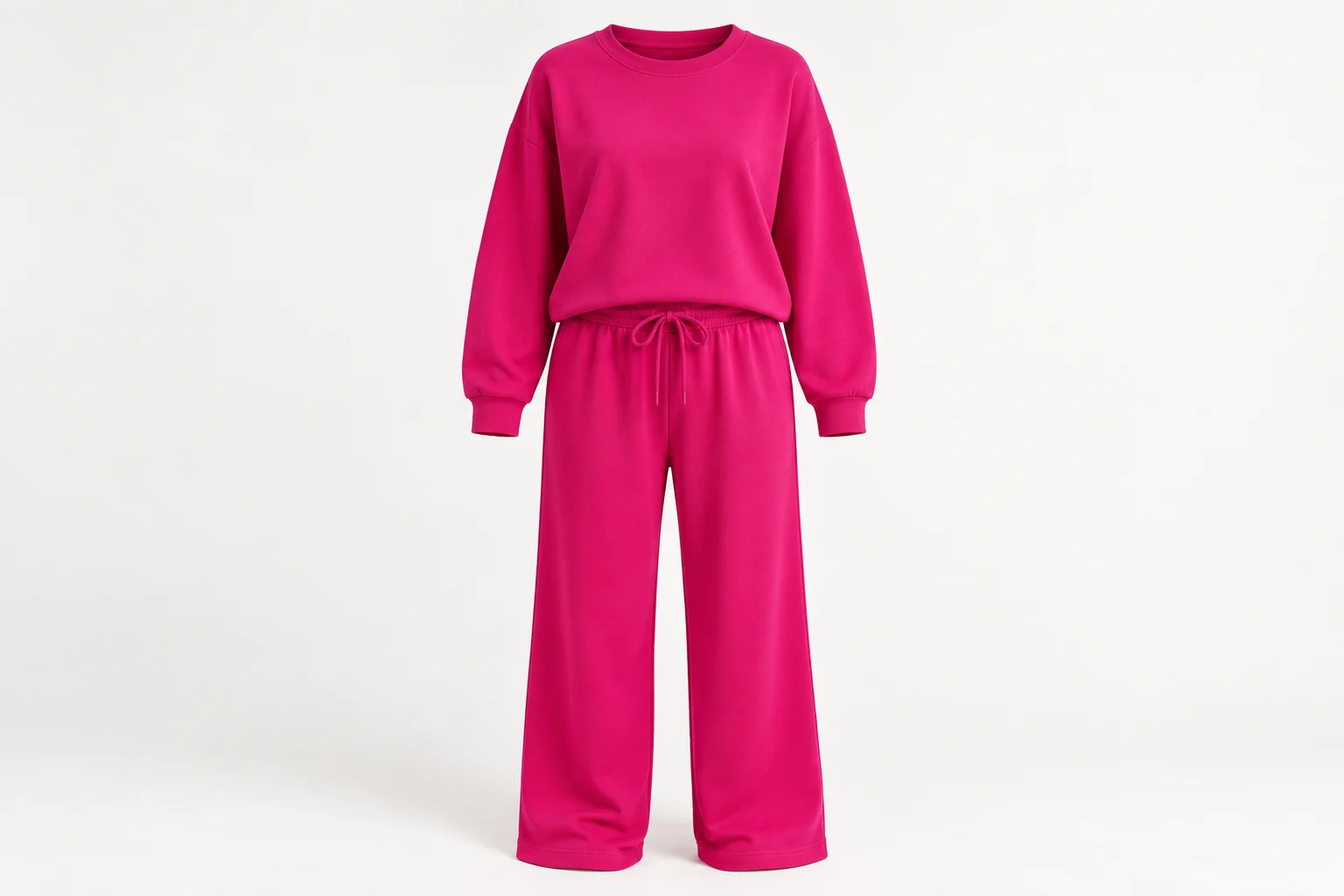
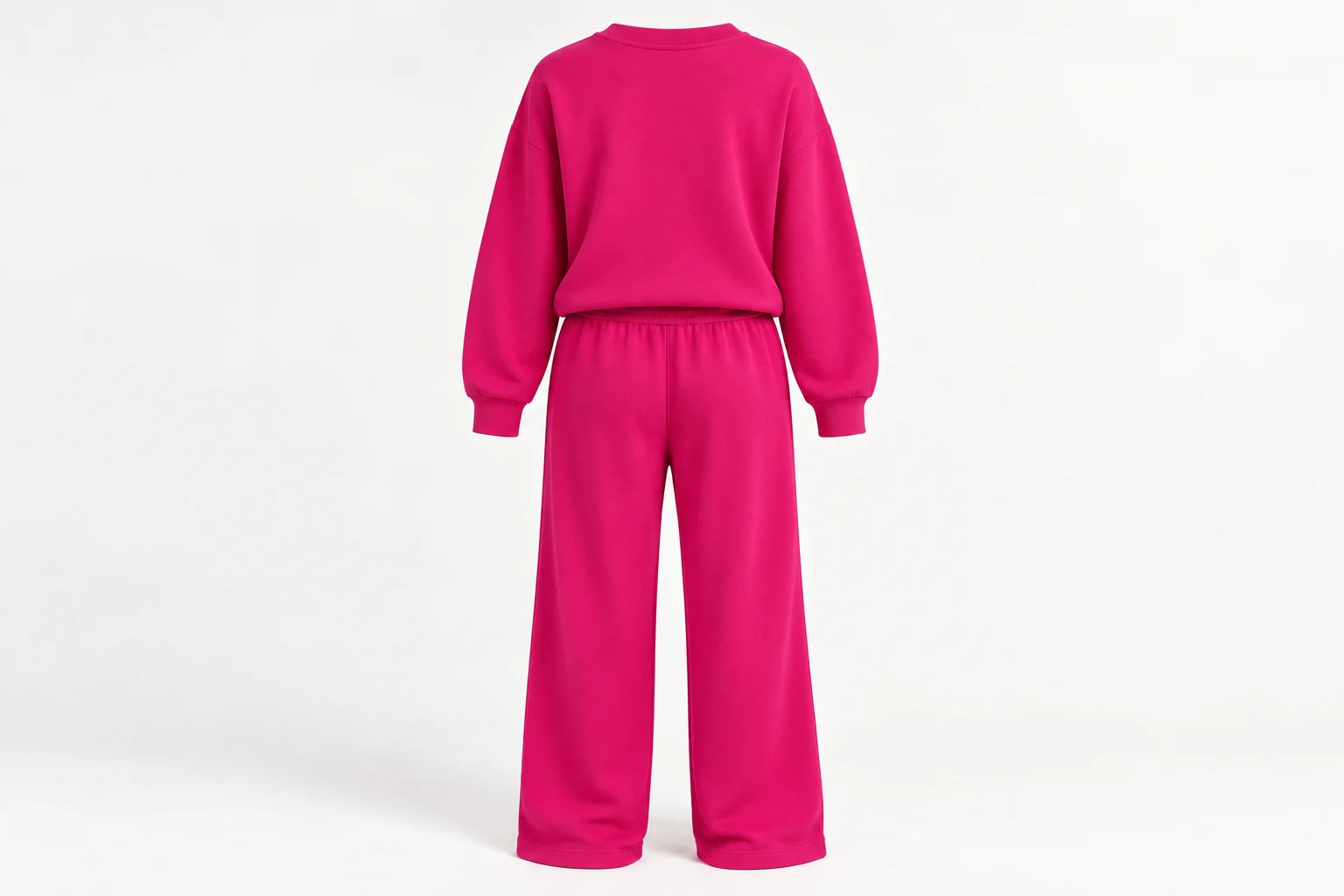
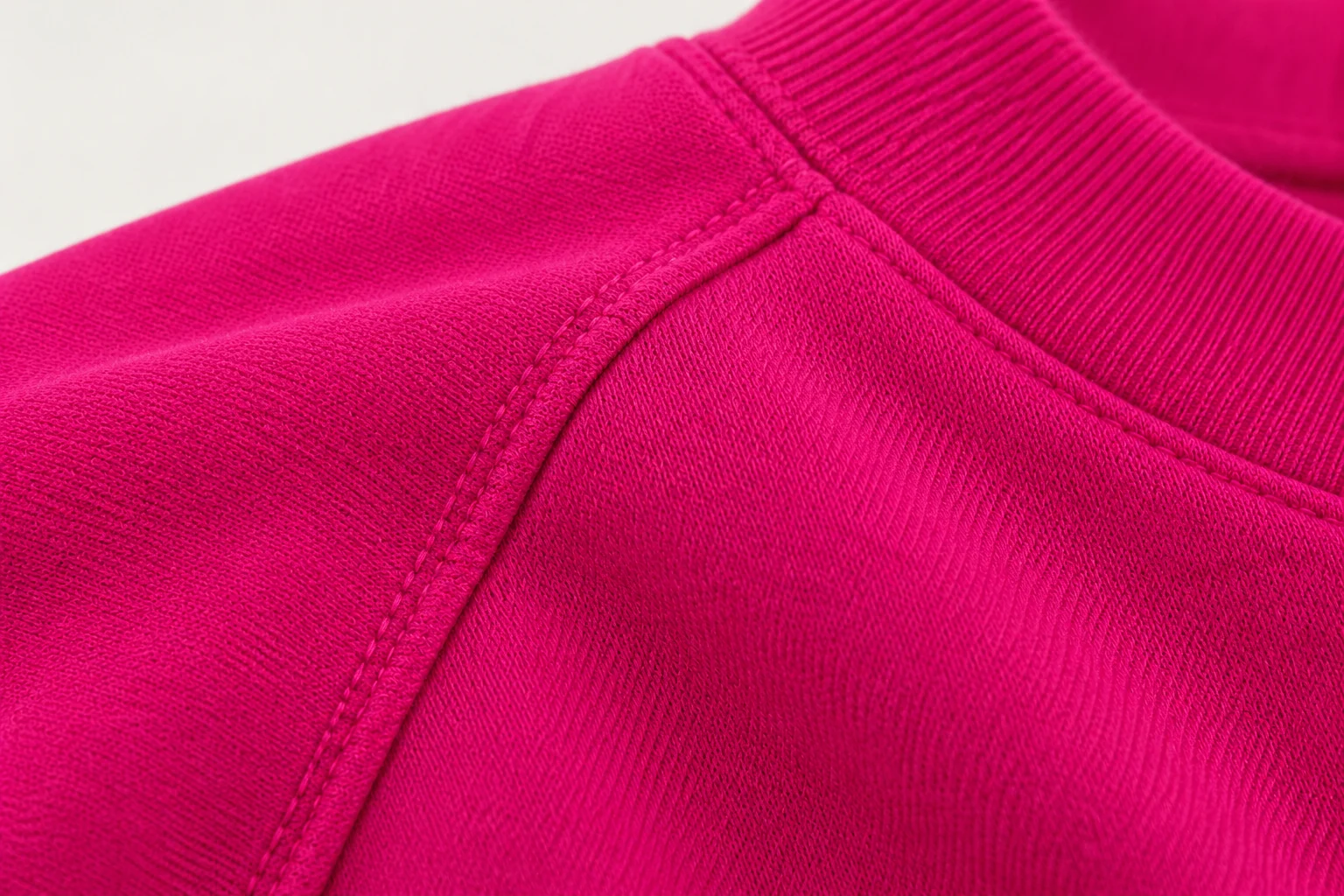
Cost the outfit that passed the seated-use review
A travel lounge set’s estimate should follow its actual top and bottom patterns, including the waist, pockets and other components retained after the adult sitting review. If that review changes rise, seat ease, top length or pocket placement, the marker must reflect the accepted version. Do not borrow a generic tracksuit total or assume a fluid jersey route and an unbrushed route need identical shapes. Identify whether the outfit uses one article throughout or an explicitly mixed proposal, and keep both piece requirements visible before combining any material quantity.
Keep the distinct body offers separate in the calculation
For the jersey calculation, identify SJ-104 as 95% modal and 5% elastane with Bio-polish + soft hand and 150, 160, 170, 180 and 190 g/m² options. The two-thread FT-601 offer records 70% cotton and 30% polyester with unbrushed + silicone, using 240, 260, 280, 300 and 320 g/m² listed options. No weight range overlaps. Ask for selected offered weight, tolerance, usable width and supply format rather than inventing a shared mass comparison. The heavier range does not establish a thermal or comfort result, and neither catalogue entry provides the outfit’s actual consumption, packed volume or present availability.
Use a paired-area illustration without assuming the same pattern
For fictional arithmetic, suppose one approved-looking top proposal occupies 0.80 square metres and its bottom 1.60 square metres before other requirements. The combined area is 2.40 square metres. At 180 g/m² that represents 432 grams; at 280 g/m² it represents 672 grams under the same assumed area. These figures are not AL KUMAŞ yields, packing weights or equivalent outfit specifications. The two routes can need different real patterns and components. The example isolates area mass only; replace it with actual marker results before comparing price or making any claim about luggage convenience.
Recalculate seat and rise changes locally
Have the pattern maker identify which panels change when the adult seated review leads to more seat ease, another rise or a revised knee shape. Request the actual revised marker at the confirmed width, not a blanket percentage on every piece. A top-hem correction can affect only the top while a changed waistband or pocket may introduce separate components. Keeping these consequences distinct lets the buyer understand the cost of the actual travel-use design decision without attributing the whole difference to a fabric’s kilogram price.
Make pockets and waist components visible to purchasing
List pocket bags, facings, elastic, drawcord or other closures only where the design includes them, identifying their materials and units. A pocket that changes for seated use may alter its pattern and attachment but not every body panel. If a waistband uses the main article in several layers, count that actual construction. Separate another material’s consumption rather than assuming it is included in a body-fabric total. The outfit estimate should explain what the wearer sat in during review, not omit internal components because they are hidden in the retail photograph.
Separate care adjustment from handling presentation
Request relevant dimensional evidence for the offered article and component package. CottonWorks describes construction, processing, sewing and care among dimensional influences, without supplying an allowance for this set. Ask the technician how the pattern accounts for the relevant results and whether compensation is already present. Show marker inefficiency, cutting loss and the agreed purchasing contingency as distinct inputs to the actual outfit calculation. A packing or presentation method is not a substitute for those calculations, and pressing a sample before costing does not demonstrate that the cared rise, knee reference or top-to-waist relationship is unchanged.
CottonWorks: Shrinkage & Skewing — Construction, manufacturing and care influence dimensional behaviour; provides no article-specific travel-set allowance or care instruction.
Compare the complete commercial proposal without a luggage claim
Show actual body and component quantities, offered weights, finishes, confirmed widths, patterns, size ratio and marker references for each accepted outfit. Use consistent units, price basis and delivery terms, and mark preliminary assumptions. Ask for separate costs if a chosen design change affects only one part of the set. Neither theoretical mass nor a lower kilogram price establishes packed bulk, wrinkle-free appearance or travel suitability. Reconcile the calculation with the sampled configuration before ordering, so a cheaper early prototype does not silently replace the outfit whose sitting and handling decisions the buyer accepted.
Technical background and scope
This is a structured editorial draft. Garment-specific development advice is paired with existing catalogue records; compatibility must be established by sampling. AL KUMAŞ supplies fabric. Cutting, sewing and finished-garment production are separate unless explicitly agreed.