



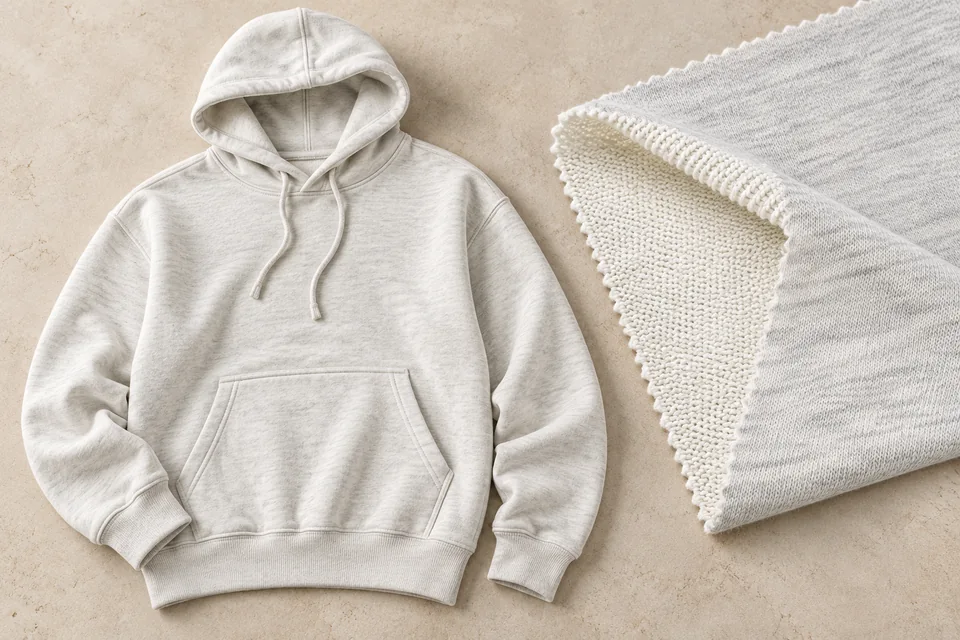
Decide what the collection should share
A hoodie, crew-neck sweatshirt and jogger can belong to one collection without sharing every material decision. Begin by identifying the common idea: colour story, surface, intended feel or a coordinated silhouette. Then decide which properties must match across styles and which can differ. A lighter sweatshirt and a fuller hoodie may be a deliberate range choice; they should not be forced into one vague fleece description merely to simplify the enquiry.
Create a three-style sheet with the garment role, proposed body route, trim needs and sample priority. For the hoodie, that priority might be the relationship between hood and body. For the crew neck, it might be neckline proportions. For the jogger, it might be the waistband and leg shape. These are design questions that a fabric cutting cannot answer by itself.
Separate loopback, unbrushed and brushed catalogue records
The current catalogue records FT-601 as 70% cotton and 30% polyester two-thread French terry, with weight options from 240 to 320 g/m². FT-602 is a 70/30 three-thread unbrushed fleece route at 300–400 g/m². FT-603 is a 65/35 three-thread brushed fleece route at 320–420 g/m². Keep those descriptions attached to the samples. Their overlapping weight ranges do not make the constructions or finishes identical.
The 2026 product planning list also contains 52/48 fleece plans and several cotton-rich alternatives. Those figures are planning specifications, not aliases for the catalogue records. A supplier offering 70/30 against a 52/48 target is proposing a change that the buyer should acknowledge. If the requested hand or construction is still being developed, say so rather than presenting the first available sample as an exact match.
Examine the garment areas that add bulk
Ask the sample room to include the actual hood, pocket, waistband and intended openings. Review how the layers meet at the neckline, pocket corners and hem. A flat body panel may look appropriate while a multi-layer detail needs another assembly decision. Have the garment producer record the pattern, seams and any reinforcement used for the sample so the team can reproduce the accepted combination.
For a coordinated set, assess the styles together. Compare the visual weight of the top and bottom, the intended fabric face, the trims and the colour relationship. If different fabric routes are proposed, record that choice openly. A shared colour reference does not remove the need to evaluate the garments as a set, and a heavier nominal weight is not evidence that one piece will perform better.
Review the finish through the intended care
CottonWorks explains that finishing and processing can affect dimensional stability, and that mechanical finishes can alter surface character. Use that background to ask focused questions about the actual offered sample. Avoid adding a shrinkage allowance, pilling grade or care-performance promise that has not been agreed and supported. Your technical team should define the relevant procedure and acceptance criteria for the finished product.
Keep an identified reference before the planned care evaluation and compare the required observations afterwards. Review garment shape, dimensions and appearance with the sample-room team. If a changed finish or trim affects the result, identify the revision and decide whether another trial is necessary. Do not use one successful fabric test as an automatic release for every style and component in the capsule.
Make the order split explicit
Give purchasing a breakdown by style, size mix, fabric route and colour. The fabric mill needs the proposed material quantities and supply requirements; the garment producer needs the pattern and consumption assumptions. A shared colour or a similar fabric name does not establish that different compositions, weights or finishes can be pooled under one production term. Ask for the supplier’s current proposal and record any pooling conditions it confirms.
Before the capsule proceeds, keep the fabric and garment approvals separate but linked. AL KUMAŞ’s role is knitted dyed fabric supply. Garment construction, decoration and finished-product approval require the parties responsible for those stages. A well-described capsule lets the buyer coordinate the look of the collection while choosing each material on evidence rather than the single word fleece.
Source and specification notes
Catalogue figures come from the recorded fabric specifications. Product-planning comparisons retain the source specifications; numeric garment SKUs are not fabric article IDs. General technical references are linked beside the relevant discussion. Development workflow recommendations are editorial guidance.
Compare source product plans ↗