



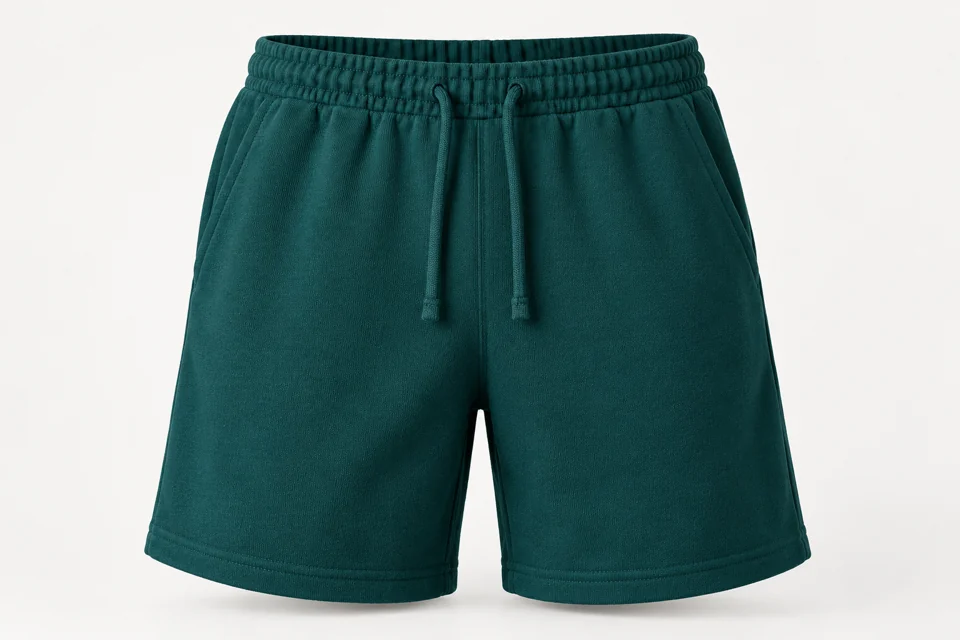


Treat the cord and exits as part of the visible design
A drawstring can be a quiet body-colour detail or a deliberate contrast crossing the front waist. Decide which relationship belongs to the short and identify the visible openings and any end components actually specified. Review the cord at the intended adjustment, not only arranged neatly for a flat photograph. If the design includes a waist graphic, show its relationship to the cord path and exit spacing. Those details can change how the front reads when gathered, so a generic artwork mock-up on an unadjusted shorts outline is only a starting point.
Identify the proposed body and its finish before decoration
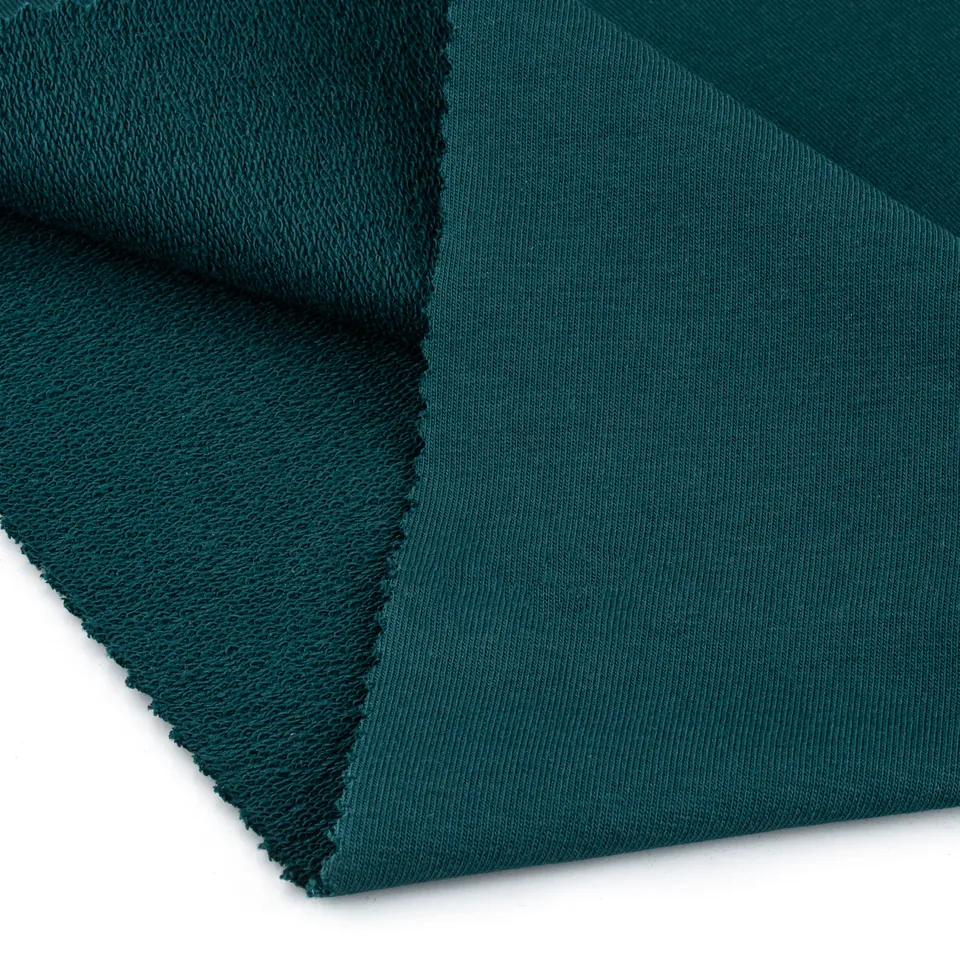
FT-601 is recorded as 70% cotton and 30% polyester two-thread French terry, unbrushed and silicone finished, at 240, 260, 280, 300 and 320 g/m². TL-701 is 80% cotton and 20% polyester loop-back terry, enzyme and silicone finished, at 250, 270, 290, 310 and 330 g/m². Ask the decorator to evaluate the exact offered article and surface. These records do not establish printing availability, process compatibility or colourfastness. A cord or casing supplied from another route needs its own identity rather than inheriting the body's shade or application approval.
Approve a cord-to-body relationship that can be reordered
Specify the governing body shade and whether the cord is intended to match, tone or contrast. Compare the actual components in a threaded waist, with any specified reinforcement or hardware visible as it will be worn. If the match is unacceptable, identify which component and reference should govern the correction. CottonWorks distinguishes findings and decorative trim from shell material; the cord's separate identity matters when ordering a replacement. A shared colour name does not demonstrate that different materials create an accepted visual relationship, particularly when gathering changes the visible proportions.
CottonWorks: Garment Construction — Findings and Trim — Findings and decorative trim have component identities distinct from the shell. Cord/body shade approval and reorder instructions are original applications requiring actual material samples.
Keep artwork out of unresolved channel operations
Mark seam lines, folds, opening locations and the actual artwork boundary on a drawing. Ask the maker and decorator to show whether an application enters a fold, is interrupted by an eyelet reinforcement or becomes concealed when the waist is adjusted. If those construction details remain provisional, do not approve a fixed front placement as though the waist were final. A graphic shifted away from one exit may then meet a pocket opening, so review the complete front panel rather than correcting each feature independently on a separate photograph.
Assess the pocket and hem in the adjusted garment
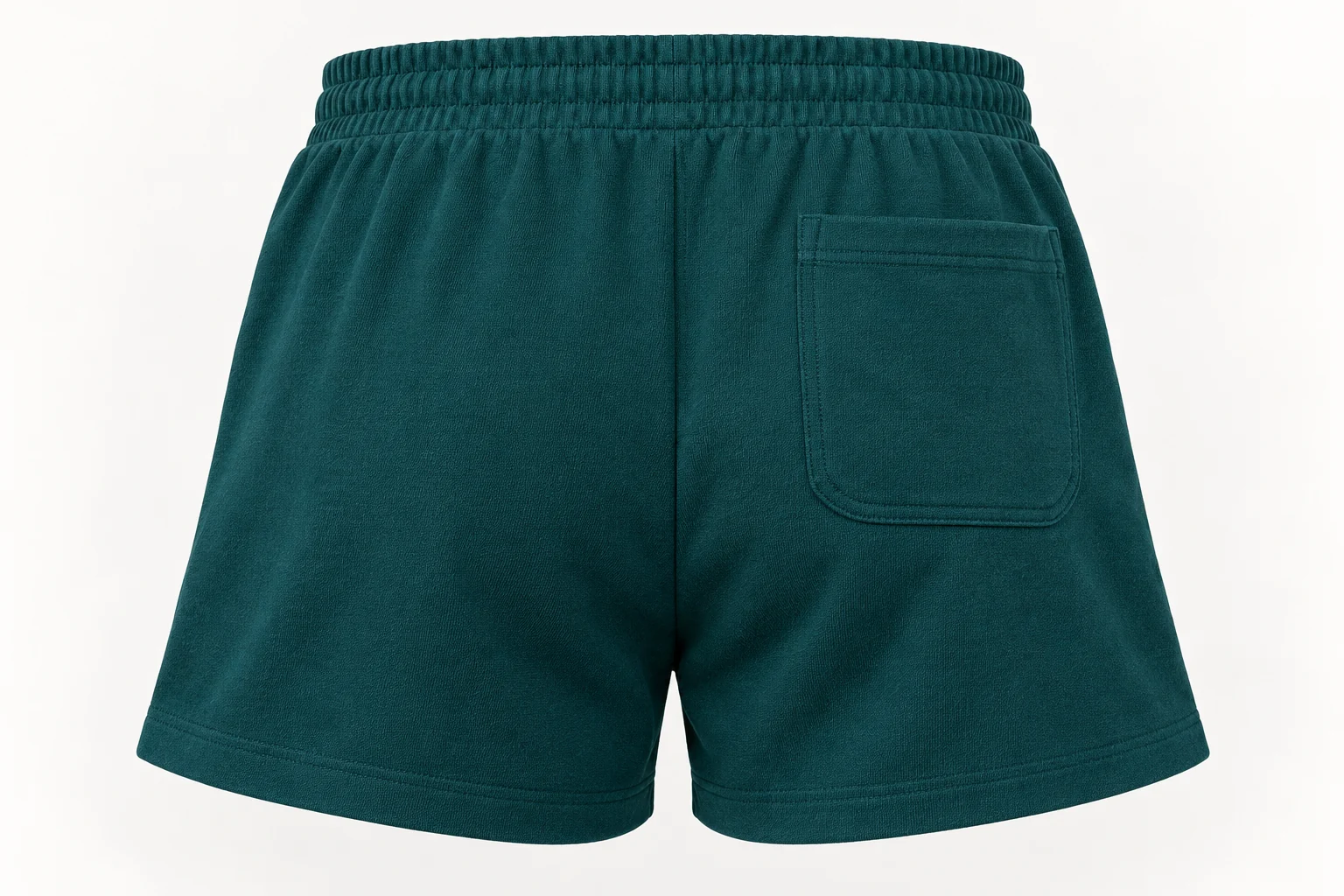
Where pockets are included, state whether a repeat or motif should align with their openings or whether a deliberate interruption is acceptable. Review that choice with the waist adjusted to the intended worn arrangement. The resulting gathering can change what is visible above the pocket without proving an application fault. Show the finished hem and any turn-up on the same placement drawing. If the pocket or channel construction changes, ask which artwork instructions must be revised; do not let an older mock-up govern a newly assembled short.
Request colour-transfer evidence for the complete component pairing
A contrasting cord moves against its channel and can enter the care process with the body and other trims. Ask the technical reviewer which colour-transfer and care questions are relevant to that actual combination. AATCC's public index separates rubbing, perspiration and laundering colourfastness categories; a qualified provider must choose applicable methods and requirements. No result is supplied for these articles or the unspecified cord. Keep visual shade acceptance separate from evidence, and record the tested component identities so a later cord replacement is not assumed to inherit another supply's results.
AATCC: Standard Test Methods and Procedures — Colourfastness — Public index separately identifies rubbing/crocking, perspiration and laundering colourfastness categories. No procedures, requirements or results for body, cord or assembled shorts are supplied.
Release a threaded and adjusted appearance reference
Retain the body, offered weight, finish, cord and component identities, physical colour references, artwork version and construction drawing with the accepted adjusted-waist photographs. State whether approval covers body shade alone or the complete decorated and threaded assembly. If exit spacing, channel depth, cord diameter or pocket placement changes, review the affected visual relationships. The final file should make the deliberate lounge-short appearance reproducible while leaving untested fastness, durability and cord-safety statements outside the approval. A polished flat lay cannot establish those properties.
Technical background and scope
This is a structured editorial draft. Garment-specific development advice is paired with existing catalogue records; compatibility must be established by sampling. AL KUMAŞ supplies fabric. Cutting, sewing and finished-garment production are separate unless explicitly agreed.