



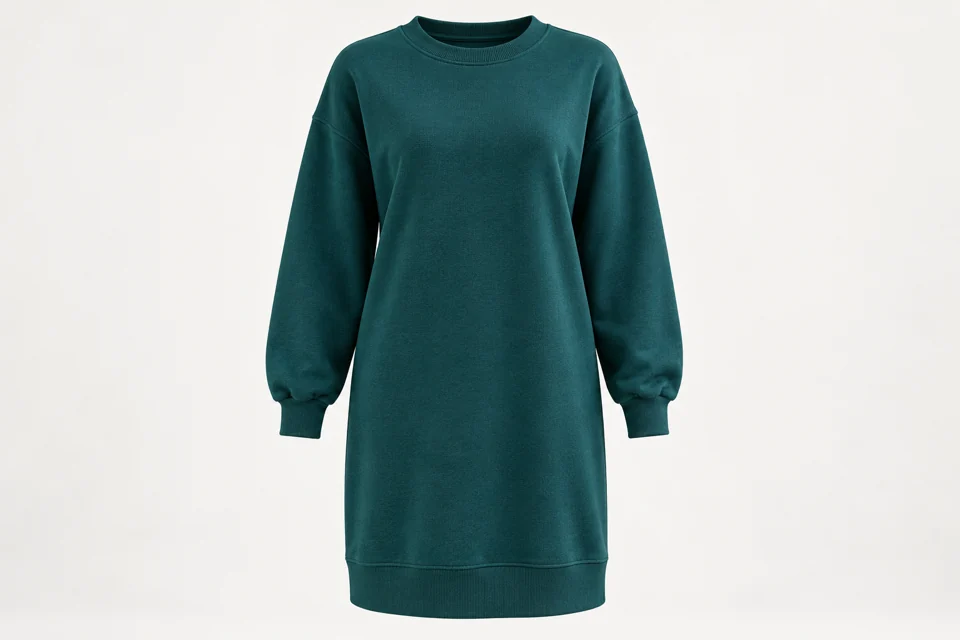


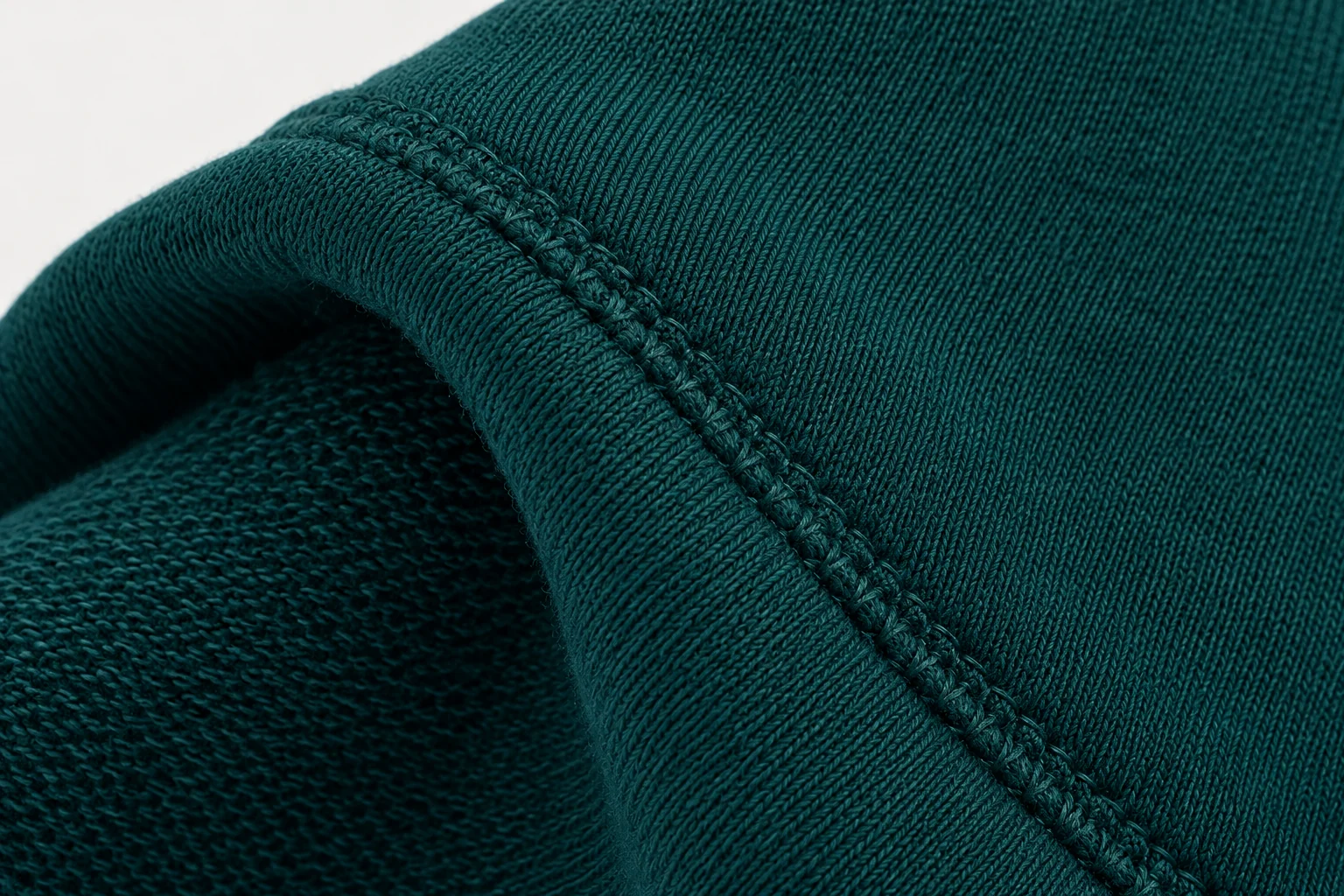
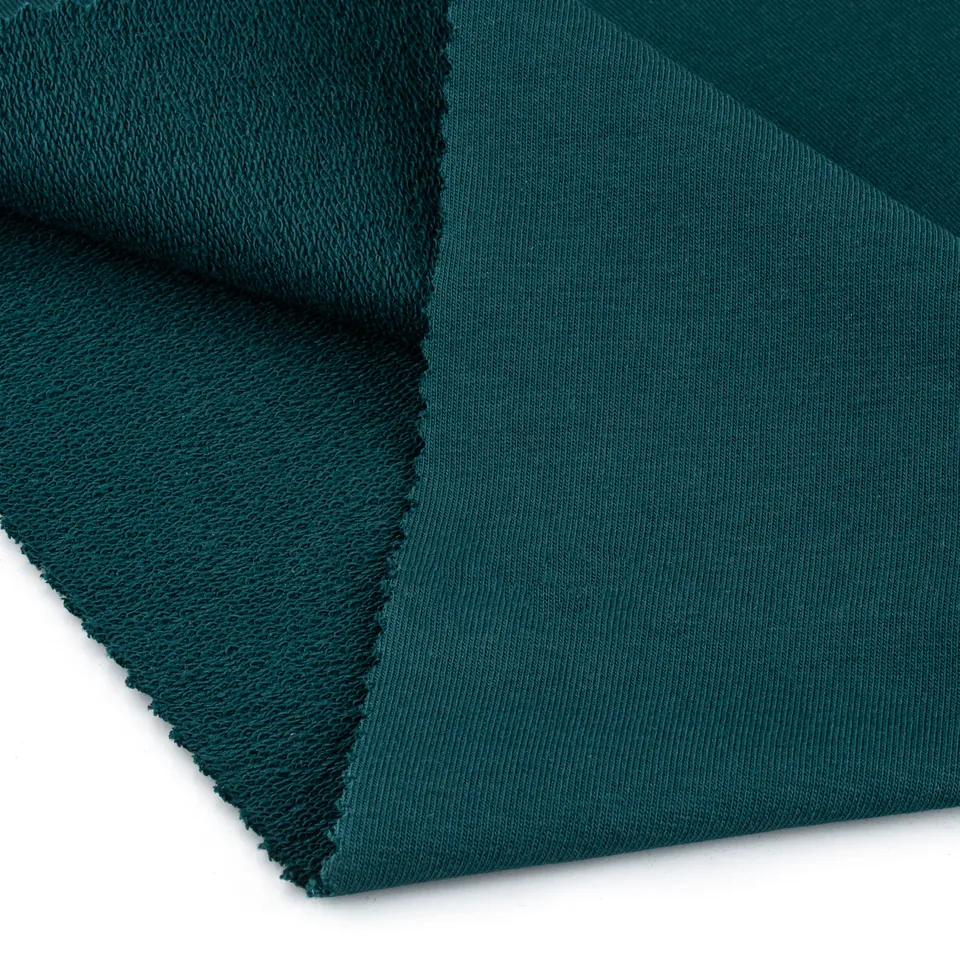
Estimate the actual extended body and its attached components
Send the cutter the complete dress front and back, sleeves where present, neckline components and actual lower-edge arrangement. Include each specified pocket, pocket bag and support piece rather than assuming they are covered by a general sweatshirt allowance. The long body is a pattern in its own right, with actual hip width and hem shape that may differ from a short crew-neck style. Give the ordered size ratio and accepted length variants before calculating demand. The material estimate should reflect the developed garment, not a sweatshirt figure increased by an unexplained percentage.
Separate theoretical body mass from its observed hang
For invented arithmetic only, suppose the net main-body panel area is 1.60 square metres. At 300 g/m² it represents 480 grams, while at 370 g/m² it represents 592 grams before sleeves, pockets, trims, cutting losses and allowances. These are not a real dress pattern or AL KUMAŞ garment weights. The example isolates mass per area and cannot predict which body will hang acceptably at the shoulders. It also cannot qualify the neckline or pocket attachment. Ask the pattern team for actual areas and assess the complete sample before treating mass as a material-selection answer.
Compare pocket-bearing and pocketless configurations explicitly
Where the design decision is still open, ask the maker and cutter to identify the exact material and operations added by the specified pockets. A patch pocket adds another visible outline; a seam pocket can require separate bags and an altered junction. Do not price them as interchangeable versions. Ask whether the intended pocket use led to any actual support or pattern correction, and include only the accepted change. The costing should make those differences visible without inventing a standard pocket capacity or using a small area calculation as evidence that the complete attachment will perform satisfactorily.
Request the long-panel layout at confirmed usable width
Have the cutter show the full body and sleeves with the actual face and direction instructions at the offered usable width. CottonWorks describes markers through the arrangement of actual garment pieces for material utilisation. Here the accepted dress length, pocket components and size ratio must underpin the layout, including any real directional restriction. Small pieces can occupy available spaces only when their construction and orientation permit it. Retain the marker version behind each offer. A theoretical kilograms-to-metres conversion cannot show whether the actual long body panels and pocket pieces fit that arrangement efficiently.
CottonWorks: Garment Construction — marker making — Markers arrange actual garment pieces for utilisation. Main-panel area/mass figures are explicitly invented, not real dress mass, confirmed consumption or evidence of acceptable hang.
Catalogue starting points
The unbrushed FT-601 route lists 70% cotton 30% polyester, 240, 260, 280, 300, 320 g/m² and Unbrushed + silicone finishing. FT-603 lists 65% cotton 35% polyester, 320, 345, 370, 395, 420 g/m² and Brushed + anti-pilling finishing. Neither entry confirms usable width, completed-dress mass or a pocket-bearing marker. Ask for the exact current offered weight, format and finish before comparing price units. The one shared nominal weight does not make the blend, finish or garment behaviour equivalent, and the anti-pilling label does not supply a measured performance result.
Keep upper and lower finishing work in the cost picture
Identify the neckline assembly, shoulder support where specified and actual hem treatment in the maker's costing. A lower band and a folded dress hem involve different components and work, even if the body material has not changed. Separate actual secondary-material demand from pattern compensation, cutting losses and purchasing buffers, stating what is already included. If a hanging or care review changes body length or pocket position, return the revised pattern to the cutter. Do not retain an early figure when the configuration behind it no longer matches the accepted full-length sample.
Compare costs against the accepted hanging conditions
Show material, actual components, pocket arrangement, lower edge, operations, size mix and pattern reference beside each proposed route. If only the empty-pocket configuration has been assessed, identify any intended use condition still unresolved before calling both versions equivalent. Ask the relevant suppliers to confirm the quotation basis, included work and actual programme charges. Recalculate targeted changes rather than hiding them inside a general heavier-fabric allowance. The buyer can then evaluate a developed sweatshirt dress and its evidence boundary instead of choosing the lowest kilogram price for an incomplete or unaccepted assembly.
Technical background and scope
This is a structured editorial draft. Garment-specific development advice is paired with existing catalogue records; compatibility must be established by sampling. AL KUMAŞ supplies fabric. Cutting, sewing and finished-garment production are separate unless explicitly agreed.