






A smaller garment can still create a complicated cutting brief
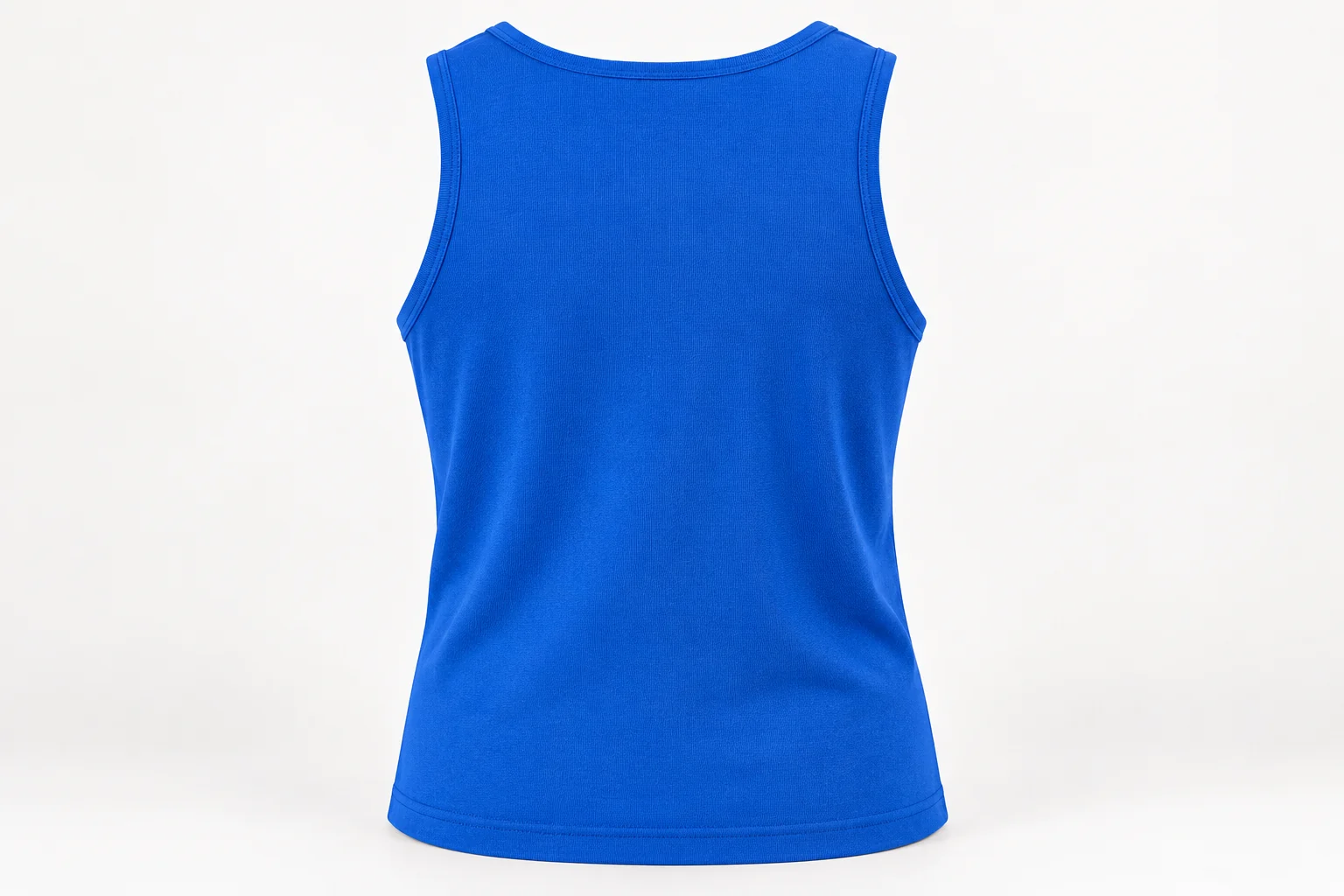
A tank top uses no sleeves, but that does not make its fabric consumption a simple subtraction from a T-shirt estimate. Front and back openings remove area from the pattern, while separate bindings may introduce narrow components with their own cutting direction and joining requirements. Begin with the actual tank pattern and finished edge plan. A purchasing comparison should identify body material, binding source, ordered size ratio and usable width before presenting a cost per garment. Otherwise a low consumption figure may merely exclude parts that another quotation includes.
Keep weight separate from the appearance of coverage
Finished GSM describes mass per square metre. It cannot, by itself, confirm whether a light-coloured tank gives the coverage the buyer wants at the chest or underarm. Look at a sewn sample in the intended fit and agree the conditions used for assessment. Comparing cuttings while they lie flat may miss how the material looks when shaped by the body. Use the chosen weight to make the offer precise, but keep coverage, handle and edge behaviour as separate approval questions instead of treating a heavier number as an automatic solution.
Compare body area and binding requirements separately
For an arithmetic example created for this guide, suppose two patterns each require 0.45 square metres of body material before cutting losses. At 180 g/m² that area represents 81 grams; at 160 g/m² it represents 72 grams. These are hypothetical areas and masses, not tank consumption or AL KUMAŞ offers. They exclude bindings, marker inefficiency and every commercial allowance. The nine-gram difference helps explain one variable, but the buyer still needs a cutter's estimate for the complete size mix. State whether binding strips come from the same body fabric or a separately purchased material.
Ask the marker planner how straps and strips are arranged
On a narrow-strap design, the outline of the upper front and back may affect how pattern pieces nest together. Send the approved grain indication and any direction restrictions rather than asking the cutter to rotate pieces freely to reach a target yield. If a separate binding strip is required, specify its cut width and direction as confirmed by the maker. Ask whether planned joins are acceptable and where they will fall. A layout that uses every narrow space may not be a useful saving if it creates an unapproved join in a visible neckline.
Recheck the marker after the opening changes
A fit correction can alter both the body outline and the binding length. If the armhole is raised or the strap widened during development, issue a revised pattern reference and ask whether consumption needs recalculation. Do not quietly preserve an early costing figure while changing the components behind it. CottonWorks explains that dimensional behaviour has several construction and processing influences; allow the sample team to establish the relevant pattern assumptions for the actual material. Keep any allowance for that behaviour distinct from a marker estimate and from the commercial buffer used for purchasing.
CottonWorks: Shrinkage & Skewing — Construction and processing contribute to dimensional behaviour, so the actual material matters to pattern assumptions. Area, mass and marker examples are original labelled calculations; this source supplies no AL KUMAŞ width or consumption.
Catalogue starting points
The heavier listed comparison is SJ-102: 95% cotton 5% elastane at 170, 180, 190, 200, 210 g/m². SJ-101 supplies the recorded 100% compact combed cotton alternative at 130, 140, 150, 160, 170 g/m². No usable width is established by those options, and a catalogue weight is not a current stock confirmation. Ask the supplier to identify which specific finished article it is offering and how width is stated. Give that confirmed information to the cutting team rather than inserting an assumed width into the cost sheet. SJ-102 carries the Enzyme + compacted finish label, while SJ-101 carries Enzyme + silicone; confirm that the offer and trial material use those recorded finishes.
Show the buyer what the costing includes
Present the body marker estimate, binding quantity, relevant pattern version and offered material assumptions together. Identify which figures came from a cutting calculation and which remain estimates. An alternative fabric may justify another sample even when its kilogram price looks attractive, because the current pattern may no longer produce the same edge or silhouette. The useful comparison is the complete proposed tank, with its actual components and unresolved questions visible. That lets a brand choose between offers without mistaking a partial material estimate for a ready-to-order production cost.
Technical background and scope
This is a structured editorial draft. Garment-specific development advice is paired with existing catalogue records; compatibility must be established by sampling. AL KUMAŞ supplies fabric. Cutting, sewing and finished-garment production are separate unless explicitly agreed.